What Is a Sagittate Leaf? An Arrow Shaped Leaf

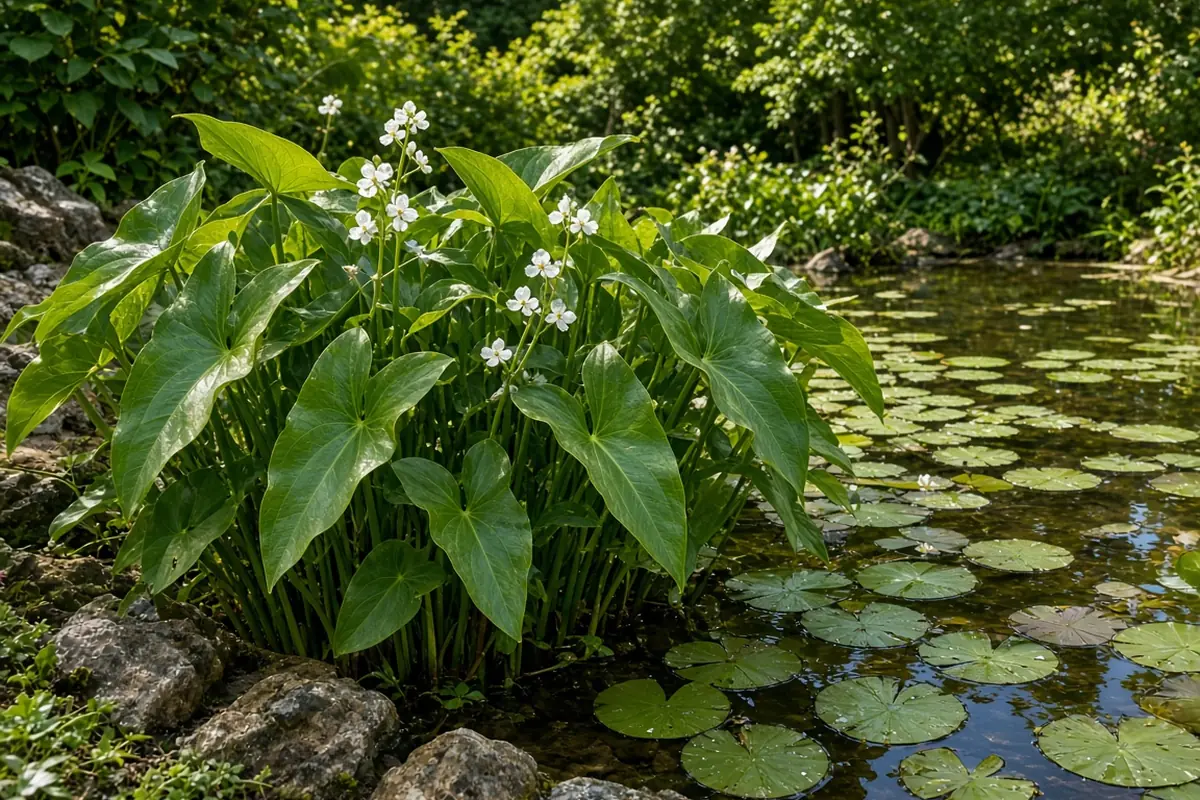
A sagittate leaf is shaped like an arrowhead, with a pointed tip plus two pointed lobes at the base that aim backward toward the stalk. NC State Extension notes the genus name Sagittaria comes from the Latin sagitta, meaning arrow, for its leaf shape.
The short answer
A sagittate leaf has an arrowhead shape with a pointed tip plus two pointed basal lobes aimed back toward the petiole. NC State Extension notes broadleaf arrowhead is named for this shape. Compare the base lobes to tell it apart from a cordate leaf, which NC State describes as heart shaped with a notch at the base.

How do you identify a sagittate leaf?
Start at the base of the blade. The NC State Extension Gardener Handbook notes leaf blade shapes plus margins help identify plants. A sagittate leaf has two pointed lobes that point backward, like the barbs of an arrow.
| Feature | What to look for | Example |
|---|---|---|
| Tip | Pointed | Broadleaf arrowhead |
| Base lobes | Two pointed lobes aimed backward | Broadleaf arrowhead |
| Overall outline | Arrowhead shaped | Green arrow arum |
| Similar shape | Heart shaped with a notch at the base | Cordate leaves |
Source: NC State Extension.
How is sagittate different from cordate?
NC State describes a cordate leaf as heart shaped or broadly ovate with the base turning in to form a notch where the petiole attaches. A sagittate leaf has pointed basal lobes, not rounded ones.
Which plants have sagittate leaves?
NC State describes broadleaf arrowhead, Sagittaria latifolia, as an aquatic perennial with triangular leaves with pointed tips. It describes green arrow arum, Peltandra virginica, with large leaves that are often arrowhead shaped.
How to: step by step
- Look at the base of the leaf blade.
- Look for two pointed lobes.
- See whether the lobes point backward.
- Contrast with a heart shaped leaf.
- Compare with a leaf whose lobes point outward.
- Find the pointed tip.
Troubleshooting
Lobes point backward: sagittate.
Lobes flare outward: hastate.
Rounded lobes with a notch: cordate, which NC State describes as heart shaped.
For leaf parts see cannabis leaf anatomy, pond water for cannabis plus companion plants when growing marijuana. Kind Seed Co also stocks cannabis seeds.
Sources
- Sagittaria latifolia (arrowhead), NC State Extension Gardener Plant Toolbox
- Peltandra virginica (arrow arum), NC State Extension Gardener Plant Toolbox
- Extension Gardener Handbook, chapter 3: botany, NC State Extension
FAQ
Is arrowhead plant sagittate?
Broadleaf arrowhead is the classic example. NC State notes its genus name Sagittaria comes from the Latin sagitta, meaning arrow, referring to the leaf shape. It describes the leaves as triangular with pointed tips plus notes they vary in length plus width, so check several leaves on the same plant.
What does sagittate mean?
Sagittate means shaped like an arrowhead. It shares a root with the Latin sagitta, meaning arrow, which NC State notes gave Sagittaria its name. In botany the term describes a leaf blade with a pointed tip plus two pointed lobes at the base that aim back toward the stalk.
Are sagittate leaves common in wetlands?
Several wetland plants have them. NC State describes broadleaf arrowhead growing in marshes, swamps, bogs plus farm ponds in shallow water up to 12 inches deep. It describes green arrow arum, with often arrowhead shaped leaves, in freshwater bogs, ponds plus marshy areas with water up to 6 inches deep.
How is sagittate different from hastate?
Both have two lobes at the base of the blade. In a sagittate leaf the lobes point backward toward the stalk, like the barbs of an arrow. In a hastate leaf the lobes flare outward to the sides. Compare the angle of the lobes to tell the two shapes apart.
Why does leaf shape matter?
The NC State Extension Gardener Handbook notes leaves, especially the shapes of their blades plus margins, are useful in identifying species plus cultivars. Learning terms like sagittate, cordate plus hastate helps you match a plant to a description in a field guide or plant database with more confidence.