
Wild Mustard in Cannabis Gardens: Spot and Stop Seed
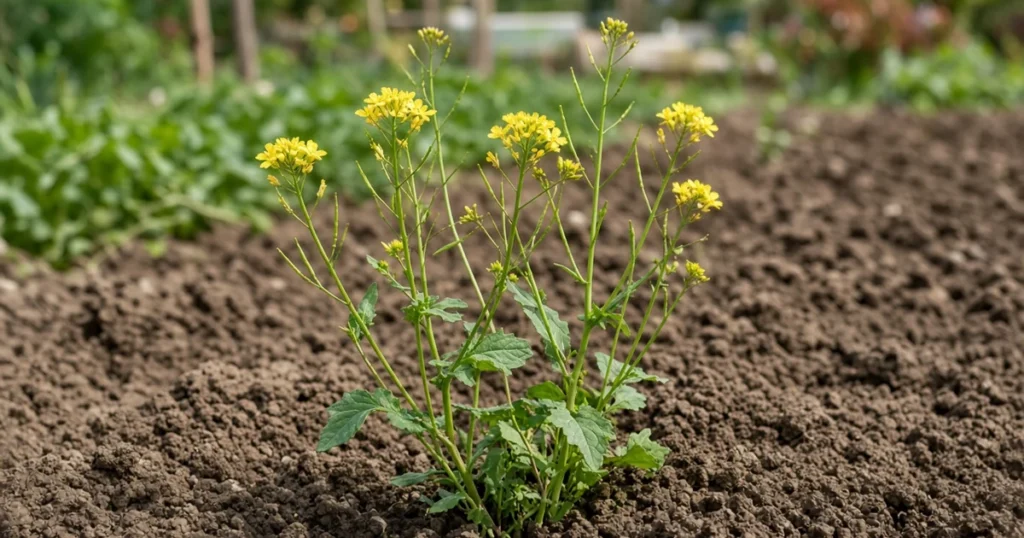
Quick answer: Wild mustard is a summer annual with bristly stems, bright yellow four petal flowers and slender beaked pods. Cornell says it establishes very quickly and peaks after spring tillage. Weed early and often, avoid heavy nitrogen, shade it out, and pull every plant before its pods ripen, because its seed can persist for many years.
What Is Wild Mustard?
It is a fast growing annual in the mustard family. Cornell University’s weed identification site calls wild mustard a weed widespread throughout the United States, mainly a summer annual in New York with smaller populations sprouting in fall. It says the seeds can persist in the soil for many years.
The Cornell College of Agriculture and Life Sciences (CALS) weed profile describes it as a highly branched summer annual that occurs throughout the farming regions of North America. In a cannabis garden, its speed is the main threat. It grows fast. Our overview of weed control in outdoor cannabis covers the wider picture.
How Do You Identify Wild Mustard?
Start by checking the seed leaves. Cornell CALS says wild mustard seedlings have kidney or heart shaped to round seed leaves, hairless and on short stalks. The weed identification site adds that they have an indentation at the tip.
Then look for these traits from Cornell:
- Young leaves. Alternate, egg to club shaped, with wavy, irregular teeth, scattered stiff hairs and sunken veins. Early leaves form a basal rosette.
- Stems. Hairy, with stiff, sparse hairs that point downward and are denser low on the stem.
- Height. Mature plants reach 16 to 40 inches.
- Leaves on mature plants. Lower leaves are long stalked, deeply lobed and broadest at the tip. Upper leaves are smaller and often stalkless.
- Flowers. Clusters of yellow, four petal flowers at the branch tips, 1/2 to 1 1/4 inches wide.
- Pods. Upright, slender and 1 to 1 3/4 inches long, ending in a tapering beak.
- Root. A thin, branched taproot with many fibrous side roots.
What Looks Like Wild Mustard?
Wild radish and white mustard. Cornell CALS says wild radish has hairier, rougher leaves, flowers with dark veined petals, and larger pods that look beaded and break into segments. Wild mustard petals lack distinct veins and its pods split open. White mustard has stalked upper leaves and hairy pods, while wild mustard pods are hairless.
Why Is Wild Mustard Hard to Cultivate Out?
It sprouts and grows very fast. Cornell CALS says the species establishes very quickly, which makes it among the hardest weeds to control with cultivation. It recommends frequent early cultivations, getting as close to the crop as your tools allow.
Cornell CALS also says wild mustard reaches peak emergence after tillage in early to mid spring, and it notes a secondary peak of emergence in the fall. Every time you turn a bed in spring, expect a flush. Our post on tilling vs no till cannabis beds covers how to limit that disturbance.
Does Fertilizer Make Wild Mustard Worse?
Yes, especially nitrogen. Cornell CALS says the growth rate and competitive ability of wild mustard increase greatly with higher nitrogen, and advises avoiding over fertilizing with nitrogen rich inputs where it is a problem. Its peak emergence is strongest when tillage follows fertilizing. Cornell CALS adds that it helps to apply nitrogen as late as possible after your plants are established.
For cannabis beds, that means timing and moderation. Our guide to manure for cannabis beds covers how to use rich amendments without overdoing them.
How Long Does Wild Mustard Seed Last?
It can last many years. Cornell’s weed identification site says its seeds can persist in the soil for many years. Cornell CALS explains part of why: most freshly shed seed is dormant, with typically about 5% germination, although 21% germinated right after shedding in one experiment. The rest waits. That slow release is why a single season of escaped plants can keep a bed busy for years.
How to Control Wild Mustard in a Cannabis Garden
- Expect a flush after spring tillage. Cornell CALS says emergence peaks after tillage in early to mid spring. Scout within about a week after tillage and keep checking.
- Cultivate early and often. Cornell CALS says frequent early cultivations pay off with this fast weed. Keep each pass shallow, as UC IPM’s landscape guide advises.
- Pull rosettes by hand near plants. Pull plants while they are young.
- Go easy on nitrogen. Cornell CALS says nitrogen greatly boosts wild mustard’s growth and competitiveness. Apply rich inputs after your plants are established.
- Shade the soil. Cornell says shading reduces wild mustard growth and seed production, and Cornell CALS calls it sensitive to shade. Close spacing and mulch both help. Our guide to mulch for cannabis compares options.
- Flush the seed bank. For a heavily infested bed, Cornell suggests a cultivated fallow period in spring to flush and destroy part of the seed bank before planting.
- Pull every plant before pods ripen. Cornell says the seed persists for many years, so do not let any plant finish.
Wild Mustard at a Glance
| Subject | Extension finding | Attribution |
|---|---|---|
| Life cycle | Summer annual, some fall emergence | Cornell |
| Mature height | 16 to 40 inches | Cornell CALS |
| Flowers | Yellow, four petals | Cornell CALS |
| Peak emergence | After tillage in early to mid spring | Cornell CALS |
| Nitrogen | Growth and competitiveness rise sharply | Cornell CALS |
| Seed | Persists for many years, most fresh seed dormant | Cornell, Cornell CALS |
Should You Use Herbicides Near Cannabis?
No. Cultivate, pull and shade. No EPA registered herbicide label lists cannabis as a use site, and state rules vary, so check your state agriculture department. UC IPM says herbicides should not normally be needed by home gardeners.
Troubleshooting Wild Mustard
A wave of seedlings follows every tilling. Cornell CALS says emergence peaks after spring tillage. Cultivate that flush while it is small.
Plants outgrow your transplants. Cornell CALS says nitrogen sharply increases its growth. Hold back rich amendments until your plants are established.
It keeps coming back for years. Cornell says the seed persists for many years. Stop every plant from seeding.
You are not sure if it is wild radish. Cornell CALS says wild radish has veined petals and beaded pods.
Open spaces fill fastest. Cornell says shade reduces its growth. Close gaps with mulch or planting.
Frequent early cultivation, hand pulling and shade from mulch or close planting keep wild mustard down in most cannabis gardens, and the Kind Seed Co weed guides cover more species.
Sources
- Cornell CALS Weed Science, Wild mustard weed profile: https://cals.cornell.edu/weed-science/weed-profiles/wild-mustard
- Cornell University Weed Identification, Wild mustard: https://blogs.cornell.edu/weedid/wild-mustard/
- UC Statewide IPM Program, Weed Management in Landscapes: https://ipm.ucanr.edu/home-and-landscape/weed-management-in-landscapes/
FAQ
When does wild mustard sprout?
Cornell says wild mustard is mainly a summer annual, with smaller numbers emerging in fall. Cornell CALS says emergence peaks after tillage in early to mid spring, especially when tillage follows nitrogen fertilizing. That means the weeks right after you prepare beds in spring are the most important time to watch for its seedlings.
How can I tell wild mustard from wild radish?
Cornell CALS says wild radish has hairier, rougher leaves and dark veined petals, while wild mustard petals lack distinct veins. Wild radish pods are larger and look beaded, breaking into segments, while wild mustard pods are smooth and split open when ripe.
Does nitrogen fertilizer make wild mustard worse?
Yes. Cornell CALS says the growth rate and competitive ability of wild mustard increase greatly with higher nitrogen fertility, and recommends avoiding over fertilizing with nitrogen rich inputs where the weed is a problem. Cornell CALS adds that applying nitrogen as late as possible after your plants are established helps reduce its advantage.
How long does wild mustard seed last in soil?
Cornell's weed identification site says wild mustard seeds can persist in the soil for many years. Cornell CALS notes that most freshly shed seed is dormant, with typically about 5% germination, though one experiment found 21%. Because the rest waits in the soil, preventing every plant from setting seed matters for years afterward.


