
Kochia in Cannabis Gardens: Western Weed Guide
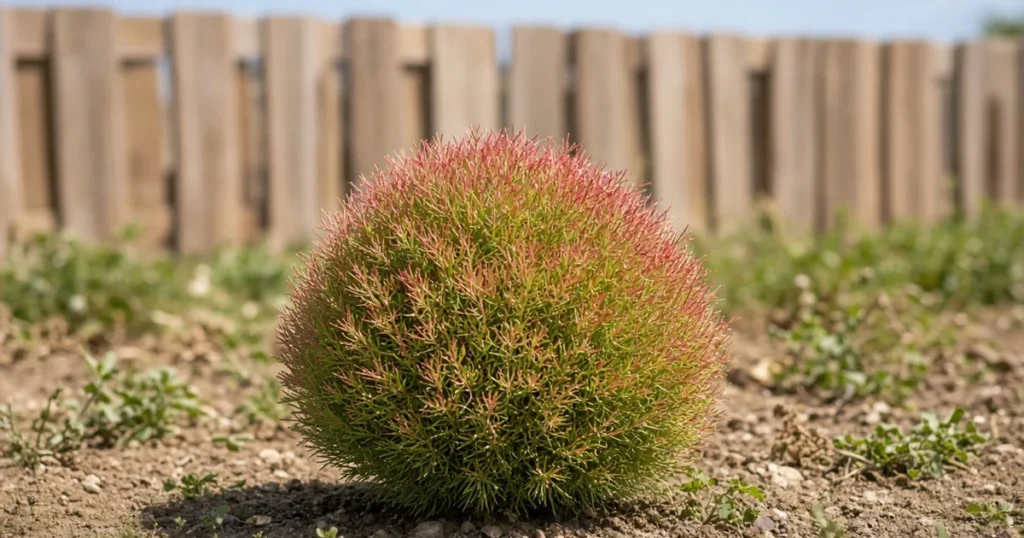
Quick answer: Kochia is a fuzzy, gray green summer annual that grows into a bush 6 feet or taller, then breaks off and tumbles to spread seed. Colorado State University Extension says its shallow taproot pulls or hoes out easily when young. Stop seed set, clear tumbleweeds from fences and remember that NDSU finds most seed dies within 2 years.
What Is Kochia?
It is a tough, drought adapted summer annual of the western US. Colorado State University Extension says kochia is a troublesome annual weed of fields, gardens, roadsides, ditch banks and small acreages. It is not native to the US and is found in all western states except Alaska. It reproduces only from seed, which makes preventing seed set the center of any plan.
North Dakota State University (NDSU) Extension says kochia has ranked among the 10 worst weeds in that state in surveys since 1978. It is adapted to drought and saline soil and grows mostly unchecked where it has no competition. Our overview of weed control in outdoor cannabis covers the wider picture.
How Do You Identify Kochia?
Look for fuzzy, narrow, gray green leaves on a cone shaped bush. Colorado State gives these traits:
- Seedlings. Spring seedlings look like a gray green mat across the ground.
- Leaves. Small, fuzzy and gray green. On older plants they are alternate, narrow, 0.5 to 2 inches long and often hairy.
- Stems. Highly branched, green or tinged red.
- Shape. Pyramid or cone shaped bushes 6 feet tall or more.
- Flowers. Inconspicuous, so the plant can set seed without showing obvious blooms.
NDSU adds that kochia is highly variable. It can be green, red or purple, tall and narrow or short and round, with wide or narrow leaves.
How Does Kochia Spread?
Mostly by tumbling. Colorado State explains that when the plant matures, the stem breaks off at the base and the whole plant becomes a tumbleweed, scattering seed as it rolls. NDSU says kochia has one of the highest seed to plant mass ratios of any weed, about 500, compared with 150 for lambsquarters and 75 for foxtail. Its seeds are weakly attached to a light, buoyant plant that the wind rolls across open ground.
A tumbling plant can carry seed into gardens downwind.
When Does Kochia Sprout?
It sprouts over a long season. Colorado State says kochia germinates many times through the growing season, often starting in March, with the last flushes from August to early September. NDSU lists an emergence range of 40 to 100°F and a maximum emergence depth of 3.25 inches, and notes that seedlings tolerate frost into the lower teens.
Because of those repeated flushes, one weeding is never the end. Plan to check beds through the summer.
How Long Does Kochia Seed Last?
Not long, and that is its weak point. NDSU calls short seed life the chink in the armor. Only about 5% of kochia seed is still viable after 1 year and about 1% after 2 years. CSU PlantTalk says that if kochia is managed for two to three years to prevent seed production and no new weeds blow in, it can be eradicated.
Can a Windbreak Stop Kochia Tumbleweeds?
It can certainly help. NDSU suggests building a biological fence, a border of tall plants that traps rolling kochia before it crosses into a field. Fences and shelterbelts serve the same purpose. Our guide to windbreaks for outdoor cannabis covers options that also protect your plants.
How to Control Kochia in a Cannabis Garden
- Pull or hoe young plants. Colorado State says kochia has a shallow taproot and can be easily pulled or hoed out at early growth stages.
- Keep checking all season. Colorado State says new flushes sprout from March to early September.
- Never let it seed. Colorado State calls stopping seed the first step, since kochia spreads only by seed.
- Bag seeding plants. If a plant has already started producing seed, Colorado State says to collect and dispose of it to prevent further infestation.
- Clear the fences. Colorado State recommends removing tumbleweeds from fence lines so they do not keep spreading seed. Fold this into your fall garden cleanup after cannabis harvest.
- Limit traffic through patches. Colorado State advises limiting people and vehicle traffic through infested areas.
- Do not rely on cutting. Colorado State says mowing or cutting are limited options and must be timed to keep plants from regrowing and setting seed.
- Cover open soil. NDSU notes that kochia thrives without competition. UC IPM’s landscape guide recommends a medium mulch 3 to 4 inches deep, and our guide to mulch for cannabis compares options.
Kochia at a Glance
| Subject | Extension finding | Attribution |
|---|---|---|
| Life cycle | Summer annual, seed only | Colorado State |
| Range | All western states except Alaska | Colorado State |
| Mature size | Bushes 6 feet or taller | Colorado State |
| Germination | Repeated flushes from March to early September | Colorado State |
| Seed viability | About 5% after 1 year, 1% after 2 years | NDSU |
| Spread | Breaks off and tumbles as a tumbleweed | Colorado State, NDSU |
Should You Use Herbicides Near Cannabis?
No. Pull, hoe and stop seed. No EPA registered herbicide label lists cannabis as a use site, and state rules vary, so check your state agriculture department. UC IPM says herbicides should not normally be needed by home gardeners.
Troubleshooting Kochia
New seedlings keep appearing all summer. Colorado State says kochia germinates many times from March to early September. Keep a regular weeding schedule.
Plants appeared with no kochia nearby. Colorado State and NDSU both describe tumbling plants that carry seed far. Check fences and the upwind edge of your property.
Cut plants still made seed. Colorado State says kochia sets seed on branches below the cut. Pull the whole plant instead.
Tumbleweeds pile up on the fence. Colorado State says to remove them. Bag them before seed drops.
The patch keeps coming back. NDSU says most seed dies within 2 years. Keep stopping seed for two to three years, CSU says, and clear tumbleweeds from fences, since new seed can blow in.
Hand pulling, hoeing and stopping seed are the core of kochia control in cannabis gardens, and the Kind Seed Co weed guides cover more species.
Sources
- Colorado State University Extension, Identification and Management of Kochia and Russian Thistle: https://extension.colostate.edu/resource/identification-and-management-of-kochia-and-russian-thistle/
- Colorado State University Extension PlantTalk, Kochia and Russian Thistle: https://planttalk.colostate.edu/topics/weeds-cultural-problems/2124-kochia-russian-thistle/
- North Dakota State University Extension, Kochia: https://www.ndsu.edu/agriculture/ag-hub/kochia
- UC Statewide IPM Program, Weed Management in Landscapes: https://ipm.ucanr.edu/home-and-landscape/weed-management-in-landscapes/
FAQ
Where does kochia grow in the US?
Colorado State University Extension says kochia is found in all western states except Alaska. It is a non native summer annual of fields, gardens, roadsides and ditch banks. NDSU adds that it is adapted to drought and saline soil, which helps explain why it does so well across dry western landscapes and open ground.
How does kochia spread so fast?
Colorado State says mature kochia breaks off at the base and becomes a tumbleweed that scatters seed as it rolls. NDSU reports one of the highest seed to plant mass ratios of any weed, about 500, compared with 150 for lambsquarters. Wind can roll a single plant far across open ground, seeding as it goes.
How long does kochia seed survive in soil?
Not long. NDSU says only about 5% of kochia seed remains viable after 1 year and about 1% after 2 years. That short life is its weak point. CSU PlantTalk says stopping seed for two to three years can eradicate it, if no new seed blows in.
What is the easiest way to remove kochia?
Pull or hoe it while it is young. Colorado State says kochia has a shallow taproot that can be easily pulled or hoed out at early growth stages. If a plant has already started making seed, collect it and dispose of it carefully, and clear any tumbleweeds caught on nearby fences.


