
Broadleaf Plantain in Cannabis Beds: Compacted Soil Weed
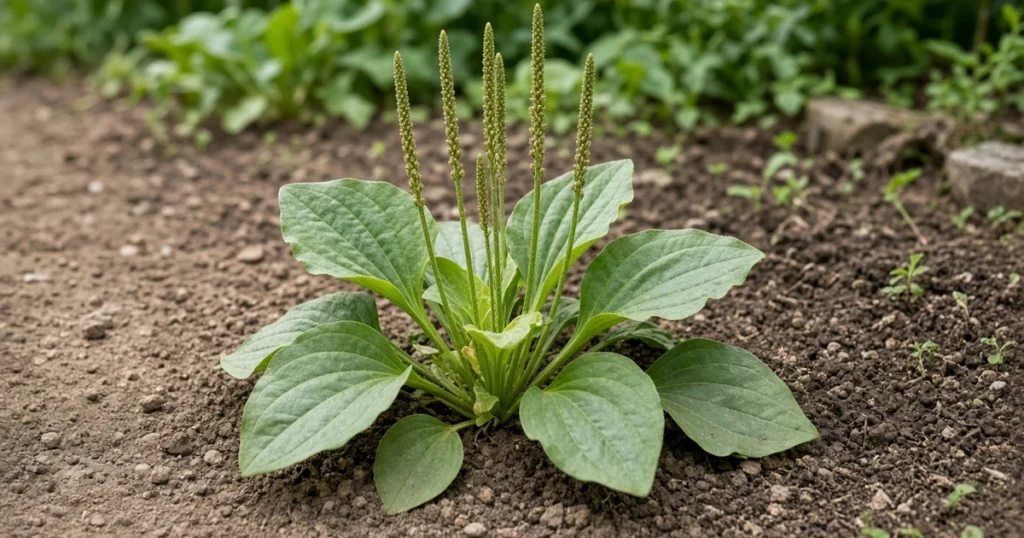
Quick answer: Broadleaf plantain is a perennial rosette with oval, strongly veined leaves that favors moist, compacted soil. UC IPM says it grows from a crown, so cutting and mowing fail. Remove seedlings and mature plants before they seed, watch the spot for months, mulch 2 to 4 inches deep and loosen the compacted ground.
What Is Broadleaf Plantain?
A low perennial that loves trampled ground. The University of California Statewide IPM Program (UC IPM) calls broadleaf and buckhorn plantain major perennial weeds found in gardens, turf, ornamental plantings, roadsides and pastures. Both were introduced from Europe. Broadleaf plantain also goes by common plantain and dooryard plantain.
UC IPM’s weed gallery lists its habitat as gardens, landscaped areas, footpaths, roadsides and other disturbed places, and says it can be found in compacted and soggy sites where other plants may not thrive. Those are exactly the conditions around a well used cannabis bed. Our overview of weed control in outdoor cannabis covers the wider picture.
How Do You Identify Broadleaf Plantain?
Look for flat rosettes of smooth, oval leaves with strong veins. The UC IPM Pest Notes and weed gallery give these details:
- Leaves. Smooth and oval, 2 to 7 inches long, with five to seven prominent veins that run parallel to the edges and meet at the base in a broad leaf stalk.
- Growth form. No true stem. Leaves cluster in a basal rosette.
- Roots. A tough, short crown with fibrous, shallow roots.
- Flower stalks. Up to 15 inches tall, topped with a dense spike of tiny flowers with white stamens. The gallery gives a bloom period of April through September.
- Fruit. Egg shaped capsules that open around the middle like a lid and release five to sixteen seeds each.
- Seedlings. Oblong seed leaves that narrow abruptly to a stalk, followed by football shaped leaves.
How Is It Different From Buckhorn Plantain?
Mostly by leaf shape. UC IPM says buckhorn plantain has longer, narrower leaves 3 to 12 inches long, a taproot, and a crown covered in tan, woolly hairs. Broadleaf plantain has broader leaves and longer flower spikes. Buckhorn favors drier, disturbed sites, while broadleaf prefers moist, compacted ground.
What Does Plantain Tell You About Your Soil?
It usually points to compaction. UC IPM calls broadleaf plantain an indicator weed of alkaline soils (high soil pH) with low fertility and soil compaction. It is also better adapted to irrigated areas.
A patch of plantain along a bed edge is a sign that the ground there is packed down. Pulling the weed without fixing the soil invites it back. Our guide to soil compaction in cannabis beds explains how to loosen ground and keep foot traffic off the root zone.
Why Does Plantain Survive Cutting?
It grows from the crown. UC IPM says plantains grow from the crown area at the soil surface, which lets them persist after the leaves are removed or mowed. Crowns can regenerate new plants even when cut off at or below the soil surface. Broadleaf plantain can live for many years and build a thick crown 6 to 10 inches across.
UC IPM adds that plantain is slow to establish but difficult to control once mature, and that relying only on pulling, digging or hoeing is hard on mature plants because of those persistent crowns.
When Do Plantain Seeds Sprout?
They sprout through the warm season. UC IPM says seeds germinate at or near the soil surface when there is enough moisture and soil reaches 50°F, with ideal germination around 77°F. The seedling stage lasts 8 to 15 weeks, which is your best window to pull new plants before they form a crown.
How to Control Broadleaf Plantain in a Cannabis Bed
- Pull seedlings early. UC IPM says early removal of new seedlings works when practiced diligently. The 8 to 15 week seedling stage is the easiest time.
- Dig out the crown on older plants. Take the whole crown, since UC IPM says crowns regrow when cut at or below the surface.
- Remove plants before seed. UC IPM says to remove new seedlings and mature plants before they produce seed.
- Monitor for months. UC IPM advises watching the area for several months to be sure plantains do not resprout, and says repeated removal over several months is most successful in a home garden.
- Mulch the bed. UC IPM says organic mulch alone may control plantain seedlings at 2 to 4 inches deep, reapplied as it breaks down. Landscape fabric works too if overlapped so light cannot reach the soil. Our guide to mulch for cannabis compares materials.
- Fix the compaction. Since UC IPM lists plantain as a compaction indicator, loosen packed soil and route walking paths away from beds.
- Clean your tools. UC IPM says plantain seed and plant parts can contaminate equipment, and advises cleaning equipment before using it in a new area. See our guide to cleaning and storing garden tools for winter.
Broadleaf Plantain at a Glance
| Subject | Extension finding | Attribution |
|---|---|---|
| Life cycle | Perennial, sometimes annual or biennial | UC IPM |
| Favored site | Moist, compacted or soggy soil | UC IPM |
| Leaf size | 2 to 7 inches with five to seven parallel veins | UC IPM |
| Bloom period | April through September | UC IPM |
| Seedling stage | 8 to 15 weeks | UC IPM |
| Mulch depth | Organic mulch 2 to 4 inches | UC IPM |
Should You Use Herbicides Near Cannabis?
No. Dig, mulch and fix the soil. No EPA registered herbicide label lists cannabis as a use site, and state rules vary, so check your state agriculture department. UC IPM says herbicides should not normally be needed by home gardeners.
Troubleshooting Broadleaf Plantain
Plants regrow from the same spot. UC IPM says the crown regenerates. Dig the whole crown and check the area for months.
It keeps showing up along paths. UC IPM lists footpaths and compacted sites as prime habitat. Loosen that soil and mulch the edge.
Mulched areas still get seedlings. UC IPM says organic mulch works at 2 to 4 inches and breaks down over time. Top it up.
The weed came in with borrowed tools. UC IPM says seed contaminates equipment. Clean tools before moving between beds.
You are not sure which plantain it is. UC IPM says broadleaf has broad oval leaves, while buckhorn has long narrow ones. Manage both the same way.
Digging, hand pulling and mulch handle plantain in most cannabis beds, and the Kind Seed Co weed guides cover more species.
Sources
- UC Statewide IPM Program, Plantains Pest Notes: https://ipm.ucanr.edu/home-and-landscape/plantains/
- UC Statewide IPM Program, Broadleaf Plantain, Weed Gallery: https://ipm.ucanr.edu/weeds-identification-gallery/broadleaf-plantain/
- UC Statewide IPM Program, Weed Management in Landscapes: https://ipm.ucanr.edu/home-and-landscape/weed-management-in-landscapes/
FAQ
Why does broadleaf plantain grow in my cannabis bed?
UC IPM says broadleaf plantain does well in moist areas with compacted soil, and lists footpaths and soggy sites as common places to find it. It is also an indicator of low fertility and alkaline soil. If it is spreading along a bed edge, the soil there is likely packed down from foot traffic.
Can I just cut plantain off at the soil line?
Cutting rarely works. UC IPM says plantain grows from a crown at the soil surface, and the crown can regenerate new plants even when cut off at or below the surface. Mowing fails for the same reason. Dig out the whole crown with a trowel or weeding tool, then watch that spot for several months.
How deep should mulch be to stop plantain?
UC IPM says organic mulch alone may control plantain seedlings when applied 2 to 4 inches deep, with the exact depth depending on mulch texture. Mulch breaks down over time, so reapply it as needed. Overlapped landscape fabric under the mulch also blocks light from reaching the soil surface.
When do plantain seeds sprout?
UC IPM says plantain seed sprouts at or near the soil surface when there is enough moisture and the soil reaches 50°F, with ideal germination around 77°F. The seedling stage lasts 8 to 15 weeks, so pulling new plants during that time keeps them from forming the tough crown that makes mature plants hard to remove.


