
Common Mallow in Cannabis Gardens: Roots and Removal
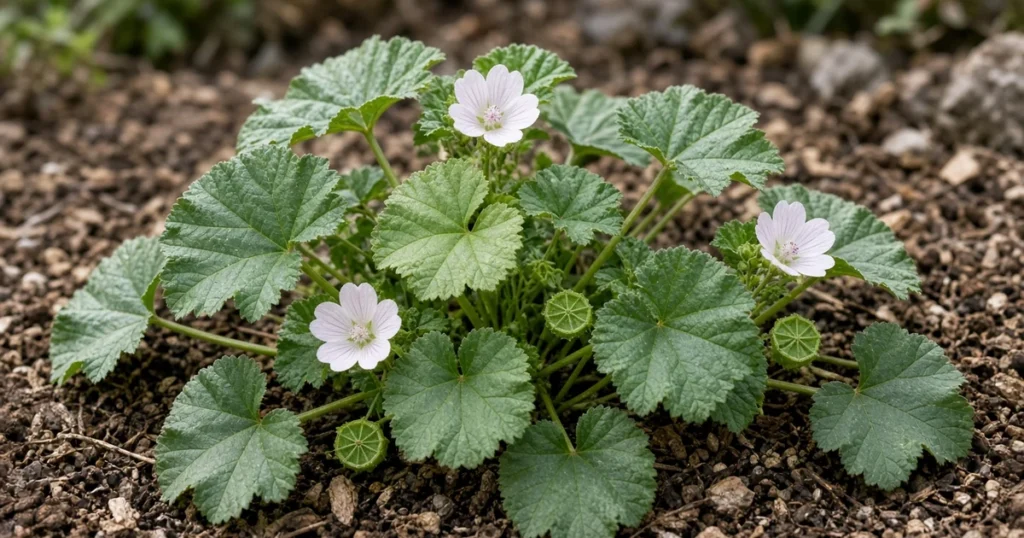
Quick answer: Common mallow, also called cheeseweed, has round, lobed leaves and a deep taproot that quickly turns woody. UC IPM says to pull young plants with four or fewer true leaves, before the root gets tough. Keep at least 3 inches of organic mulch in place, and remove every plant before its cheese wheel fruit drops seed.
What Is Common Mallow?
It is a low, spreading weed with a stubborn root. The University of California Statewide IPM Program (UC IPM) says weedy mallows are related to hibiscus and okra, and that they start growing with the first rains of fall. They quickly develop a deep taproot that becomes woody and makes the plant very difficult to remove by hand or even with tools.
UC IPM says common mallow is often called an annual, winter annual or biennial because it can be found growing all year. Utah State University Extension adds that it can be annual, biennial or perennial depending on conditions, and that it commonly grows in planting beds and bare patches. Our overview of weed control in outdoor cannabis covers the wider picture.
How Do You Identify Common Mallow?
Look for round, crinkled leaves on long stalks. UC IPM and Utah State give these traits:
- Seedlings. Heart shaped seed leaves with smooth edges, UC IPM says, followed by nearly round first leaves notched where the long stalk attaches.
- Leaves. Five to seven rounded lobes with a somewhat crinkled look, according to UC IPM. Utah State describes them as coin shaped, 1/2 to 1 1/2 inches across, with wavy edges.
- Habit. Spreading and matted, 4 inches to 2 feet high in Utah State’s description.
- Flowers. White to light pink or light purple, in the leaf joints, UC IPM says. Each of the 5 petals is notched at the tip, so a flower can look like it has 10.
- Fruit. A round, flat, buttonlike structure that looks like a tiny wheel of cheese, with 10 to 12 sections that each hold one seed.
- Root. A deep taproot, which Utah State notes can branch.
Why Is Mallow So Hard to Pull?
The taproot grows fast and turns woody. UC IPM says the long taproot develops rapidly, so pulling works best when the plant has four or fewer true leaves. As the root matures it becomes woody and very difficult to cut or pull out. As the plant matures, pulling gets much harder.
When Does Mallow Sprout?
It sprouts across a long season. UC IPM says mallows begin growing with the first rains in fall. Utah State says seeds germinate throughout the growing season when there is enough moisture, from mid spring to early autumn, with flowers and fruit from early summer to mid fall. Mature plants may stay green through winter.
That spread of timing means mallow can show up in a cannabis bed in almost any season. A sweep of beds after the first fall rains, as part of fall garden cleanup after cannabis harvest, catches the fall flush.
How Long Does Mallow Seed Last?
It lasts a long time. UC IPM says new mallow plants come only from seed, though an established plant can regrow from its crown, as noted below. The seed has a tough coat that gives low germination each year but long seed viability. That combination means a few plants left to seed can keep feeding new seedlings for years. UC IPM warns that if mallow is allowed to produce seed, the amount in the soil will cause growing problems in future years.
Do Cutting, Mowing or Solarization Work on Mallow?
Mostly no. UC IPM says young mallow can be killed by cutting at the crown, but older plants may resprout. Mowing is not effective, because the plants have live buds on the stems below the blade, and common mallow’s low habit makes it even less affected. UC IPM also says solarization is not effective for mallow, and neither is flaming. Our guide to soil solarization for cannabis beds is still useful for other weeds, but do not count on it here.
Why Does Mallow Matter Near Cannabis?
Mostly because, in farm crops, it can harbor pests. UC IPM says that in crops, mallow can host or shelter whiteflies and thrips, and can serve as a reservoir for a number of plant viruses those insects can carry. Keeping mallow out of and around your beds removes one place those pests can wait.
How to Control Common Mallow in a Cannabis Garden
- Scout after fall rains and through summer. UC IPM ties sprouting to the first fall rains, and Utah State says seed germinates from mid spring to early autumn.
- Pull at four leaves or fewer. UC IPM says pulling works best at that stage, before the taproot develops.
- Hoe young plants. UC IPM says mallows are best controlled mechanically by hoeing or pulling young plants.
- Cultivate large flushes. For many young plants, UC IPM suggests shallow cultivation set to pull plants or cut the taproot below the soil.
- Remove plants before seed. Utah State says to hand pull plants in beds before seed matures. UC IPM says removing plants before they seed reduces problems in later years.
- Mulch at least 3 inches deep. UC IPM says at least 3 inches of organic mulch such as bark or wood chips makes it hard for seedlings to emerge, but must be kept at that depth. Our guide to mulch for cannabis compares options.
- Shade it out. UC IPM says competitive plants reduce mallow germination and growth with their shade.
Common Mallow at a Glance
| Subject | Extension finding | Attribution |
|---|---|---|
| Life cycle | Annual, winter annual or biennial, sometimes perennial | UC IPM, Utah State |
| Root | Deep taproot that turns woody | UC IPM |
| Best pulling stage | Four or fewer true leaves | UC IPM |
| Germination | Mid spring to early autumn, and with first fall rains | Utah State, UC IPM |
| Seed life | Low yearly germination, long viability | UC IPM |
| Mulch depth | At least 3 inches, maintained | UC IPM, Utah State |
Should You Use Herbicides Near Cannabis?
No. Pull, hoe and mulch. No EPA registered herbicide label lists cannabis as a use site, and state rules vary, so check your state agriculture department. UC IPM says herbicides should not normally be needed by home gardeners.
Troubleshooting Common Mallow
The root will not come out. UC IPM says the taproot turns woody fast. Pull at four leaves or fewer next time, and dig older plants.
Cut plants grew back. UC IPM says older plants may resprout from the crown. Remove the root, not just the top.
Seedlings push through the mulch. UC IPM says mulch must stay at least 3 inches deep. Top it up.
Solarizing did not help. UC IPM says solarization and flaming are not effective on mallow. Rely on pulling and mulch.
New plants every year from the same spot. UC IPM says the seed has long viability. Stop every plant from seeding and keep at it.
Early pulling, hoeing and deep mulch keep mallow in check in most cannabis gardens, and the Kind Seed Co weed guides cover more species.
Sources
- UC Statewide IPM Program, Mallows Pest Notes: https://ipm.ucanr.edu/home-and-landscape/mallows/
- Utah State University Extension, Common Mallow, Ornamental Pest Guide: https://extension.usu.edu/planthealth/ipm/ornamental-pest-guide/weeds/w_common-mallow
- UC Statewide IPM Program, Weed Management in Landscapes: https://ipm.ucanr.edu/home-and-landscape/weed-management-in-landscapes/
FAQ
Why is common mallow so hard to pull out?
UC IPM says mallow quickly develops a deep taproot that becomes woody as it matures, making the plant very difficult to remove by hand or even with tools. That is why UC IPM recommends pulling plants when they have four or fewer true leaves. Older plants usually need digging to get the whole root out.
Why is common mallow called cheeseweed?
UC IPM says the fruit is a round, flat, buttonlike structure that looks like a tiny wheel of cheese, which gave the plant the common name cheeseweed. Each fruit has 10 to 12 sections that each hold one seed. Removing plants before the fruit matures keeps those seeds out of your beds.
Does mulch stop common mallow?
It helps when it is deep enough. UC IPM says at least 3 inches of organic mulch, such as bark or wood chips, makes it physically hard for seedlings to emerge and screens out light. The mulch must be maintained at that depth, or seedlings can push through. Utah State also recommends 3 inches.
How long does mallow seed stay in the soil?
UC IPM says mallow seed has a tough coat that gives low germination each year but long viability. A few seeds sprout each season while the rest wait. Because of that, a patch can keep producing seedlings for years. Stopping every plant from setting seed is the main way to wear the supply down.


