
Shepherds Purse in Cannabis Beds: Spot It Early
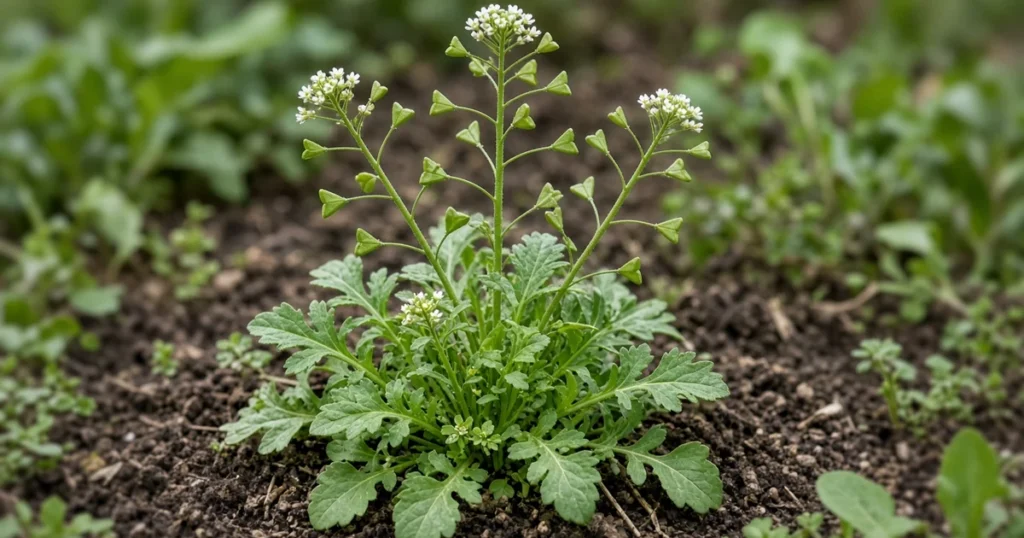
Quick answer: Shepherd’s purse is a small winter annual in the mustard family that forms a flat rosette, then sends up a stalk of tiny white flowers and heart shaped pods. Cornell says its seedlings are so small that early control is very effective. Pull rosettes from moist soil in fall or early spring and mulch the bed.
What Is Shepherd’s Purse?
It is a small, fast mustard. University of Maryland Extension describes shepherd’s purse as a winter annual broadleaf weed in the mustard family that spreads by seed. The University of California Statewide IPM Program (UC IPM) calls it a winter annual that may grow year round in cool coastal areas, found in gardens, nurseries, landscaped areas and other disturbed places.
Cornell University’s weed identification site says that in New York it acts as a winter or summer annual, either sprouting in fall and overwintering or sprouting in spring. It is a common weed of disturbed soils. Our overview of weed control in outdoor cannabis covers the wider picture.
How Do You Identify Shepherd’s Purse?
Start by looking closely at the hairs. UC IPM says true leaves are covered with star shaped hairs that set shepherd’s purse apart from most other weed seedlings. Cornell adds that it is the only weedy mustard in New York with star shaped hairs, which makes it easy to identify even before pods form.
Other traits:
- Rosette. Until the flower stem forms, plants sit as flat rosettes, UC IPM says. Rosette leaves run about 1 1/5 to 4 inches long, with edges from nearly smooth to deeply lobed.
- Stem leaves. Sparse, small and stalkless, with lobed bases that clasp the stem, according to UC IPM.
- Height. UC IPM gives about 20 inches. Maryland says up to 1 1/2 feet in areas that are not mowed, and Cornell says the flowering stem can reach about 30 inches.
- Flowers. Four small white petals, sometimes tinged pale pink, UC IPM notes.
- Roots. Cornell describes a thin, branched taproot with fibrous side roots.
What Do the Seed Pods Look Like?
They look like little hearts. UC IPM says the flat, heart or triangle shaped pods make shepherd’s purse easy to recognize when mature and set it apart from other mustards. Each pod has two chambers divided by a narrow ridge and opens to release many seeds. Cornell CALS says the seedpods are 0.5 to 1 cm long by 0.25 to 0.8 cm wide, and Maryland notes the seam along the middle.
UC IPM says the seeds are tiny, about 1 mm long and reddish to yellowish brown. Pods form at the bottom of the flower spike while new flowers keep opening at the top, Cornell explains, so one plant can drop seed for weeks.
When Does Shepherd’s Purse Sprout?
Mostly in fall and spring. Maryland Extension says germination happens in late summer, early autumn or early spring. UC IPM says flowering occurs mostly in late winter or spring but can happen year round under favorable conditions. Cornell says spring flowering continues into early summer, with a possible second round in late fall for plants that sprout in fall.
For a cannabis garden, that means beds are most at risk after harvest and before spring planting. Our guide to fall garden cleanup after cannabis harvest is the right moment to check.
Why Is Early Control So Effective?
Because the seedlings are tiny and fragile. Cornell says shepherd’s purse seedlings are very small, and control at that life stage is very effective. Light cultivation works well then. Cornell also says dense planting and organic mulches are very effective because the plant is so small early in life.
How to Control Shepherd’s Purse in a Cannabis Bed
- Scout in late summer, fall and early spring. Maryland gives those as the germination windows.
- Pull rosettes from moist soil. Maryland says hand pulling or a weeding tool works well at the start of an infestation and on young weeds, and moist soil makes it easier.
- Hit seedlings while tiny. Cornell says control at the small seedling stage is very effective. A light pass with a hoe clears them fast.
- Cultivate fall flushes. Cornell says fall cultivation works well on fall sprouting plants. Keep it shallow, as UC IPM’s landscape guide advises, and see our post on tilling vs no till cannabis beds.
- Mulch the cleared bed. Cornell calls organic mulch very effective. UC IPM’s landscape guide recommends a medium mulch 3 to 4 inches deep. Our guide to mulch for cannabis compares materials.
- Remove plants before pods mature. UC IPM says pods open to release many seeds. Pull plants as soon as the flower stalk appears. Cornell CALS notes that immature pods will continue to ripen and shed seeds even after the plant has been uprooted, so bag or remove pulled plants that carry flowers or pods, and do not leave them on the bed.
- Keep the bed full. Cornell CALS says dense planting helps, since the weed is always short.
Shepherd’s Purse at a Glance
| Subject | Extension finding | Attribution |
|---|---|---|
| Life cycle | Winter annual, sometimes summer annual | UC IPM, Maryland, Cornell |
| Family | Mustard family | Maryland, Cornell |
| Key trait | Star shaped hairs on leaves | UC IPM, Cornell |
| Mature height | About 20 inches, flowering stem up to about 30 inches | UC IPM, Cornell |
| Seed pod | Flat, heart or triangle shaped, 0.5 to 1 cm | UC IPM, Cornell |
| Best control | Small seedling stage | Cornell |
Should You Use Herbicides Near Cannabis?
No. Pull, hoe and mulch. No EPA registered herbicide label lists cannabis as a use site, and state rules vary, so check your state agriculture department. UC IPM says herbicides should not normally be needed by home gardeners.
Troubleshooting Shepherd’s Purse
Rosettes appear right after harvest. Maryland says it sprouts in late summer and early autumn. Clear beds then and mulch.
You keep missing the seedlings. Cornell says they are very small. Look for the star shaped hairs Cornell describes on the first leaves.
Plants seeded while still flowering. Cornell explains pods form at the bottom while flowers open on top. Pull plants as soon as stalks appear.
Pulling breaks the plant off. Maryland says moist soil makes pulling easier. Water first.
You are not sure which mustard it is. UC IPM and Cornell say the heart shaped pods and star shaped hairs identify it.
For shepherd’s purse in cannabis beds, early pulling, light hoeing and a good layer of mulch usually do the job, and the Kind Seed Co weed guides cover more species.
Sources
- UC Statewide IPM Program, Shepherd’s purse, Weed Gallery: https://ipm.ucanr.edu/weeds-identification-gallery/shepherds-purse/
- University of Maryland Extension, Shepherd’s purse: https://www.extension.umd.edu/resource/shepherds-purse
- Cornell CALS Weed Science, Shepherd’s purse weed profile: https://cals.cornell.edu/weed-science/weed-profiles/shepherds-purse
- Cornell University Weed Identification, Shepherd’s purse: https://blogs.cornell.edu/weedid/shepherds-purse/
- UC Statewide IPM Program, Weed Management in Landscapes: https://ipm.ucanr.edu/home-and-landscape/weed-management-in-landscapes/
FAQ
How do I identify shepherd's purse?
Look for star shaped hairs on the leaves. UC IPM says they set shepherd's purse apart from most other weed seedlings, and Cornell calls it the only weedy mustard in New York with that trait. Mature plants also carry flat, heart or triangle shaped seed pods on a stalk of tiny white flowers with four petals.
When does shepherd's purse sprout?
Maryland Extension says shepherd's purse germinates in late summer, early autumn or early spring. Cornell notes it can sprout in fall and overwinter, or sprout in spring. UC IPM says it flowers mostly in late winter or spring. For outdoor cannabis, that puts the main risk in empty beds after harvest and before planting.
What is the best way to get rid of shepherd's purse?
Catch it early. Cornell says the seedlings are very small, so control at that stage is very effective, and organic mulch and dense planting also work well. Maryland recommends hand pulling young plants when the soil is moist. Remove any plant with a flower stalk before its pods mature and release seed.
Is shepherd's purse in the mustard family?
Yes. Maryland Extension and Cornell both place shepherd's purse in the mustard family. UC IPM says its flat, heart or triangle shaped pods make it easy to tell apart from other mustards when mature. Each pod has two chambers and opens to release many tiny seeds, so pull plants before pods ripen.


