
Flea Beetles on Cannabis: Shot Holes in Seedling Leaves
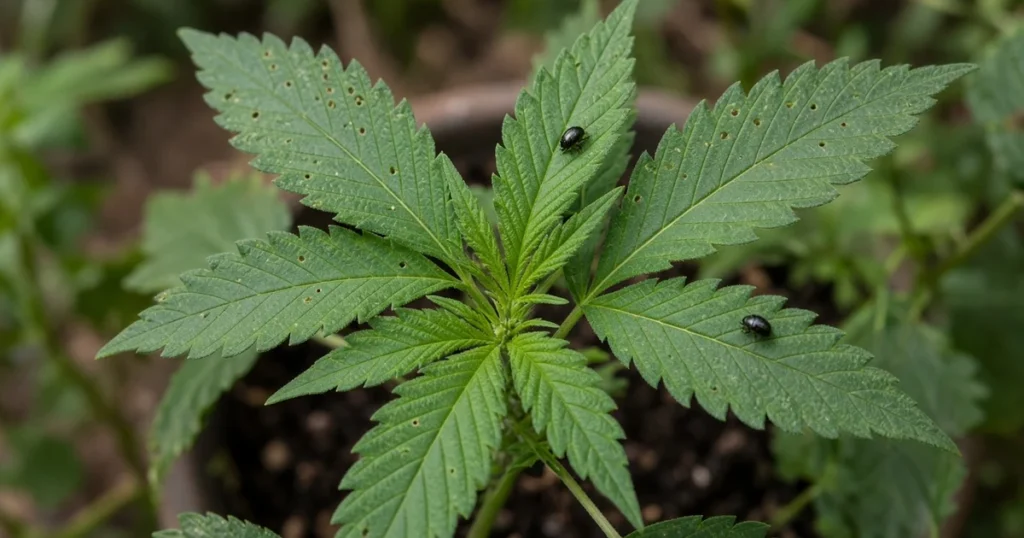
Quick answer: If young cannabis leaves are peppered with tiny round holes and small dark beetles hop away when you brush the plant, flea beetles are the likely cause. Colorado State University Extension says the damage matters most while seedlings are getting established and is usually minor on older plants. UC IPM and the University of Maryland’s extension service recommend clearing garden debris where adults spend the winter and covering young plants with row covers until they outgrow the risk.
What Are Flea Beetles?
Flea beetles are tiny leaf beetles with enlarged back legs built for jumping. UC IPM describes them as shiny and less than 1/10 inch long, and says they leap like fleas when disturbed. Maryland Extension adds that adults are oval, shiny black or brown, and that some species carry white or yellow stripes.
There are many kinds. Colorado State notes that dozens of species live in that state alone, and that most prefer a narrow group of related plants. Some feed on nightshade crops like potatoes and tomatoes, while others favor cabbage and its relatives. The palestriped flea beetle has the widest host list, taking in many weeds plus lettuce, beans, squash, corn, potatoes and sunflowers.
None of the three sources list cannabis as a main host. Maryland Extension says flea beetles feed on almost every vegetable to some degree, so a cannabis bed near brassicas, eggplant or weedy edges can pick up visitors.
How Do You Spot Flea Beetle Damage?
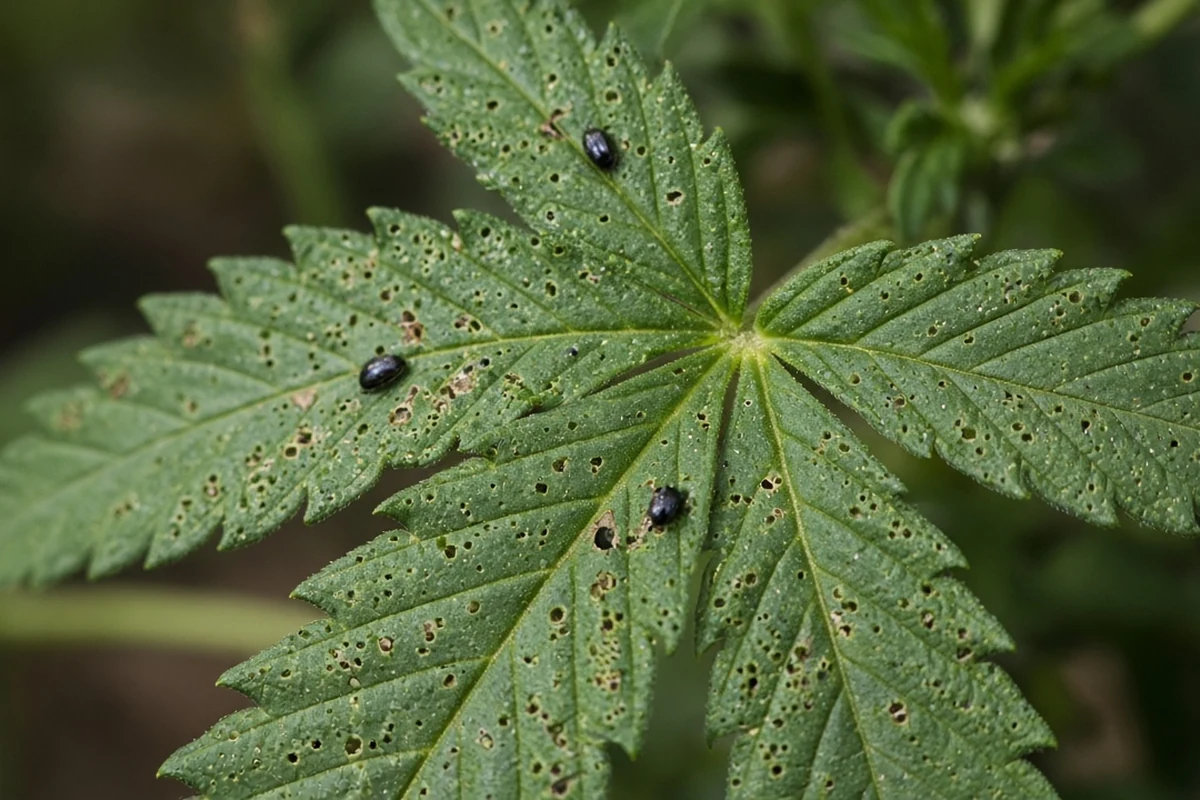
Look for shot holes. Colorado State says adult beetles chew small pits that turn into holes resembling damage from fine buckshot. Groups of beetles feeding together, UC IPM says, can cover leaves with bleached pits or ragged holes.
Other signs from the three sources:
- Tiny beetles that jump off in every direction when you touch the plant
- The heaviest damage on tender seedlings, which Maryland Extension says are often targeted
- Holes that appear in spring as adults become active
- Pale, wormlike larvae in the soil, which usually do little harm according to Colorado State
Shot holes can come from other causes. Our guide to cannabis plant problem checklist covers leaf spots that turn into holes, and armyworms leave larger chewed patches. See armyworms on cannabis if the holes are big and ragged with droppings nearby.
Do Flea Beetles Hurt Cannabis Yield?
Usually not on established plants. Colorado State reports that an established plant has to lose at least 20 to 30 percent of its leaf area before yield drops. In the UC IPM account, the damage is not usually serious beyond the early seedling stage.
Seedlings are the exception. Colorado State says growth can be badly set back on young plants and that severe infestations can kill them. That makes transplant week the key time to protect a cannabis bed.
When Are Flea Beetles Most Active?
In spring and early summer. Maryland Extension says flea beetles are one of the earliest insects to emerge, with adults appearing in late April to early May. Colorado State says they become active on warm days in early to mid spring and can fly long distances looking for host plants.
Weather plays a role. Maryland Extension notes that populations run high after mild winters and that the beetles favor hot, dry spring weather. UC IPM and Maryland Extension both report one or two generations each year, and Colorado State says some soil developing species manage two or three.
How to Protect Cannabis From Flea Beetles
- Clean up in fall. UC IPM and Maryland Extension both advise removing garden debris to cut overwintering sites.
- Pull nearby weeds. Colorado State notes that mustard weeds such as flixweed feed early generations of cabbage flea beetles. Our post on keeping weeds out of outdoor cannabis covers removal.
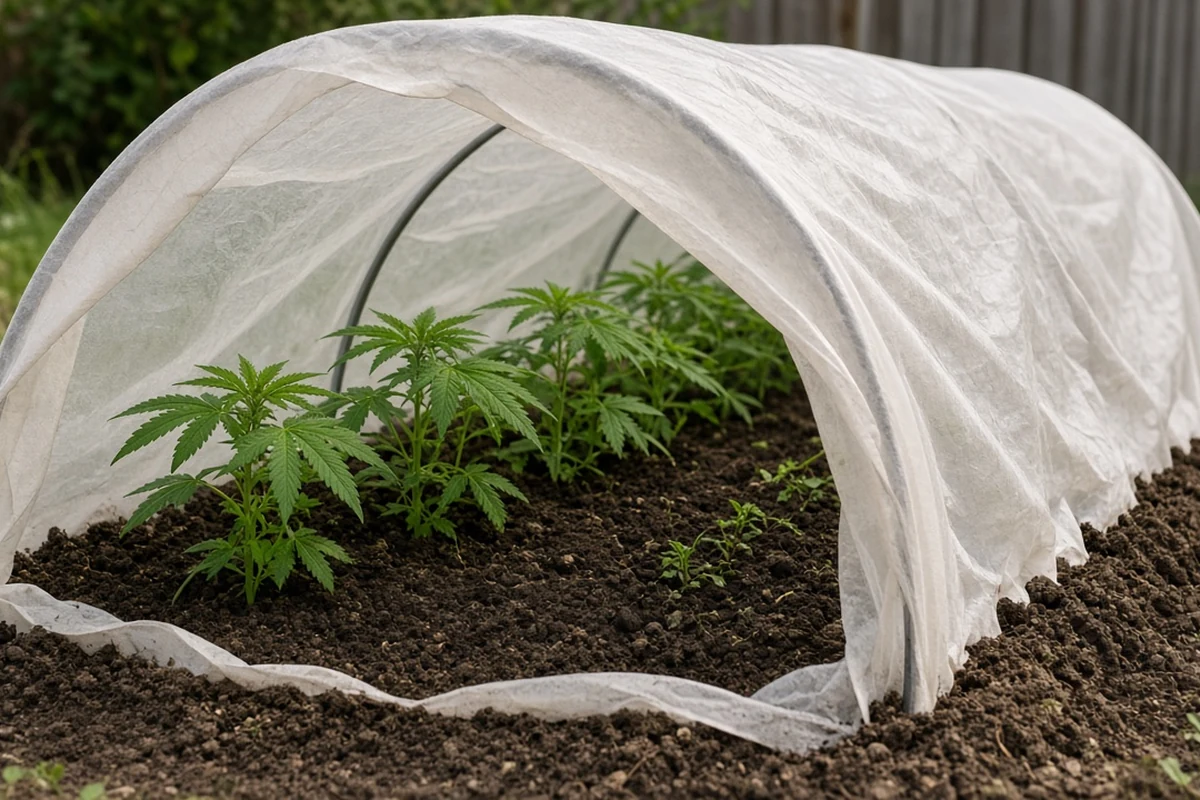
- Cover young plants. Maryland Extension suggests a row cover with its edges secured to the ground. UC IPM says seedlings can stay covered until about the sixth leaf stage. See row covers for cannabis for setup.
- Use hoops. Maryland Extension recommends draping row cover over hoops rather than resting it on plants.
- Transplant sturdy starts. Colorado State suggests using transplants so plants can outgrow injury quickly. Our post on hardening off cannabis seedlings helps them settle in.
- Keep plants growing fast. Maryland Extension says vigorous plants that grow quickly can usually outpace light feeding.
- Monitor with traps. UC IPM notes white sticky traps can monitor or catch adults.
- Till lightly. Maryland Extension says light tilling in spring or fall may help reduce populations.
Barriers and Cultural Controls Compared
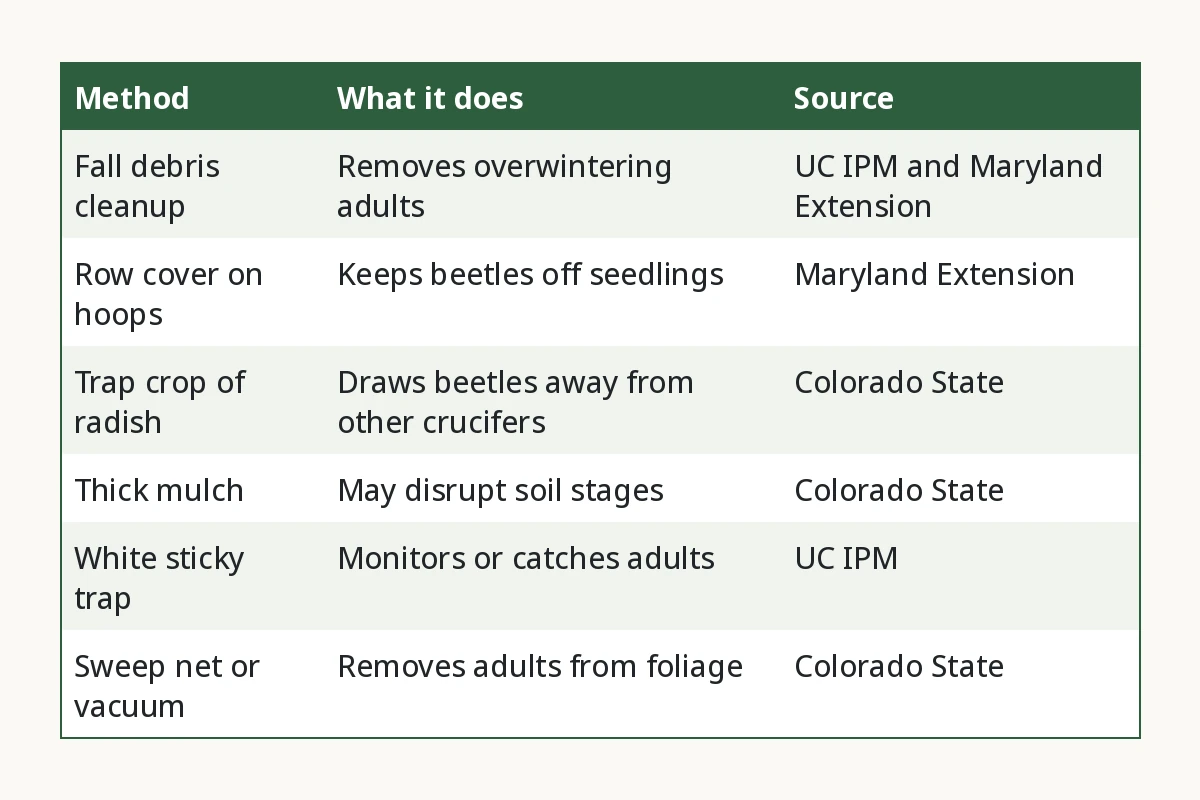
| Method | What it does | Source |
|---|---|---|
| Fall debris cleanup | Removes overwintering adults | UC IPM and Maryland Extension |
| Row cover on hoops | Keeps beetles off seedlings | Maryland Extension |
| Trap crop of radish | Draws beetles away from other crucifers | Colorado State |
| Thick mulch | May disrupt soil stages | Colorado State |
| White sticky trap | Monitors or catches adults | UC IPM |
| Sweep net or vacuum | Removes adults from foliage | Colorado State |
Colorado State cautions that netting and vacuuming must be repeated often, since beetles jump away and reinvade quickly.
Should You Spray for Flea Beetles?
Usually not on cannabis. UC IPM says insecticides are rarely needed and work poorly once numbers climb. Colorado State says any flea beetle product must be registered for the crop you are growing, so read the label carefully. Many garden insecticides carry no cannabis use on their labels.
Maryland Extension mentions kaolin clay as a repellent barrier that must be reapplied after rain. Use only products labeled for your crop and state. Our post on insecticidal soap for cannabis explains safe spray timing for other soft bodied pests.
Do Natural Enemies Control Flea Beetles?
Partly. Colorado State says flea beetles have many natural enemies, including predators, parasitoids and pathogens, and that most of these attack the larvae and help lower overall numbers. It also notes that adults are so mobile that no biological control a gardener can buy is likely to cut damage in a planting.
That is why barriers matter more than releases. Protecting helpful insects still pays off across the season. See the best bugs for a cannabis grow for allies worth keeping.
Troubleshooting Flea Beetles
Holes keep appearing under row cover. The edges may not be sealed, or beetles overwintered in the soil inside. Maryland Extension stresses securing the cover to the ground. Clear debris before covering.
Seedlings stall after heavy feeding. Colorado State says growth can be seriously set back. Keep them covered and well watered until new leaves outpace the damage.
Damage is worst along the outer rows. According to UC IPM, often only a few outside rows need attention. Focus barriers there.
Beetles are everywhere after a mild winter. Maryland Extension says populations rise after mild winters. Start covering plants earlier the next spring.
Older plants have holes but look healthy. Colorado State says established plants tolerate a lot of leaf loss. No action is likely needed.
Sticky traps catch nothing. Place white traps near young plants and check them often, as UC IPM describes.
Sources
- UC Statewide IPM Program, University of California, Flea Beetles: https://ipm.ucanr.edu/home-and-landscape/flea-beetles/
- University of Maryland Extension, Flea Beetles on Vegetables: https://www.extension.umd.edu/resource/flea-beetles-vegetables
- Colorado State University Extension, Flea Beetles: https://extension.colostate.edu/resource/flea-beetles/
FAQ
What do flea beetles look like?
They are tiny, shiny, oval beetles under 1/10 inch long, black or brown and sometimes striped, according to UC IPM and Maryland Extension.
Why are flea beetles called that?
They jump like fleas. Their enlarged hind legs, UC IPM explains, let them leap away when disturbed.
Do flea beetle larvae harm cannabis roots?
Rarely. Colorado State says soil dwelling larvae normally cause little significant damage.
How long should I keep row cover on?
Until about the sixth leaf stage. UC IPM suggests keeping it on until seedlings reach about the sixth leaf stage, when they are less likely to be damaged.
Can flea beetles spread disease?
They can on vegetables. Maryland Extension says adults can transmit viral or bacterial diseases on vegetables.
Will flea beetles come back next year?
They may. Adults overwinter in plant debris and under leaves, as UC IPM and Colorado State describe, so fall cleanup matters.


