
Henbit in Cannabis Beds: Cool Season Weed Guide
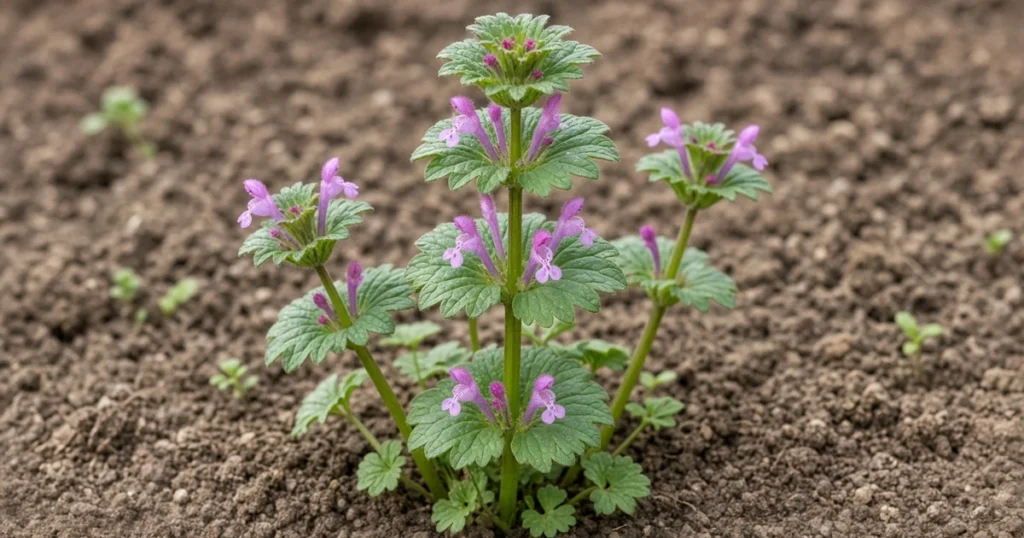
Quick answer: Henbit is a low winter annual in the mint family with square stems, scalloped leaves and small purple tubular flowers. Iowa State Extension says preventing seed production is the key to managing it. Pull or hoe henbit in fall or early spring, before your cannabis goes in, and mulch the cleared soil.
What Is Henbit?
A winter annual broadleaf in the mint family. The University of California Statewide IPM Program (UC IPM) calls henbit a widespread winter annual or sometimes biennial, found in gardens, lawns, landscaped areas, fields and roadsides. Purdue University’s Plant and Pest Diagnostic Laboratory says henbit grows in disturbed soils and soils with little residue cover, including gardens and areas alongside buildings.
UC IPM adds that dense infestations in winter crops can reduce yield significantly. In a cannabis garden, henbit is mostly a problem of timing. It fills bare beds over the cool months and is in full growth right when you want to prepare soil for spring. Our overview of weed control in outdoor cannabis covers the wider picture.
How Do You Identify Henbit?
Check the stem first of all. Iowa State says henbit, like other mint family plants, has square stems. UC IPM gives the rest of the profile:
- Height. Mature plants reach about 1.3 feet, with stems that often branch near the base.
- Leaves. Roughly 2/5 to 1 inch long, sparsely hairy, and broadly egg or heart shaped to nearly round with rounded teeth.
- Leaf attachment. Middle and upper leaves are stalkless and wrap close to the stem, while lower leaves sit on stalks.
- Flowers. Clusters of slender, reddish or purplish tubular flowers 1/2 to 3/4 inch long, arranged in rings at the bases of upper leaves. UC IPM gives a bloom window of March through August.
- Seedlings. Oval to nearly round seed leaves with smooth edges and hairy stalks, followed by hairy, broadly oval leaves with rounded teeth.
Iowa State University Extension adds that henbit leaves are rounded with deep lobes and dense hairs, and that the upper leaves attach directly to the stem with no leaf stalk.
How Is Henbit Different From Purple Deadnettle?
The upper leaves give it away. Purdue says henbit has leaves attached directly to the flowering stems, while purple deadnettle leaves sit on stalks. Purple deadnettle leaves are also more triangular with shallow lobes, and its upper leaves are often red to purple tinted, unlike henbit.
Both are winter annuals in the mint family with square stems and purple flowers, according to Iowa State, so they are managed the same way. Getting the ID right mostly helps you know what to expect next season.
Why Does Henbit Matter Before Planting?
It can slow down spring soil work. Purdue notes that the plants flower around April and form patches of purple color. It also warns that the biomass henbit produces in spring can delay drying of soils, which is why timely control before planting is needed.
A wet, matted bed is hard to work and slow to warm. Clearing henbit before it bulks up in spring gives you a bed that dries and can be prepared on schedule.
Can Henbit Set Seed Without Opening Its Flowers?
Yes. UC IPM says some henbit plants are self pollinated and produce small flowers that never open. That means seed can form even if you never see a showy bloom. The fruit is four small nutlets held in a tube, and the plant reproduces by seed alone.
That habit is why Iowa State calls preventing seed production the key to management. Waiting until you see purple flowers can be too late for some plants.
When Is the Best Time to Control Henbit?
Fall or early spring works best. Iowa State says preventing seed production is key to managing henbit, and notes that once plants are flowering, full control is less likely. Pulling small plants when you clean beds after harvest, then checking again before spring planting, fits that window. Our guide to fall garden cleanup after cannabis harvest pairs well with a henbit check.
How to Control Henbit in a Cannabis Bed
- Scout after harvest. Henbit is a winter annual, so look for the small round seedlings in bare beds through fall.
- Pull or hoe while young. UC IPM’s landscape guide says to remove young weeds by hand before they flower and set seed. UC IPM notes the stems often branch near the base.
- Keep hoeing shallow. Iowa State lists tillage as an effective option. UC IPM advises shallow cultivation and warns that deep tilling brings buried weed seed to the surface. Our post on tilling vs no till cannabis beds covers that tradeoff.
- Recheck in early spring. Iowa State says early spring is the other effective window. Clear any new plants before they bulk up and slow soil drying, as Purdue describes.
- Do not wait for purple flowers. UC IPM says some plants form seed from flowers that never open.
- Mulch bare soil. UC IPM recommends a medium mulch kept 3 to 4 inches deep to block light from weed seeds. Our guide to mulch for cannabis compares materials.
- Avoid leaving beds bare. Purdue notes that henbit favors soils with reduced residue cover, so covered ground gives it fewer openings.
Henbit at a Glance
| Subject | Extension finding | Attribution |
|---|---|---|
| Life cycle | Winter annual, sometimes biennial | UC IPM |
| Family | Mint family with square stems | Iowa State |
| Mature height | Up to about 1.3 feet | UC IPM |
| Bloom period | March through August | UC IPM |
| Key leaf trait | Upper leaves attach directly to stem | Purdue, Iowa State |
| Management key | Prevent seed production | Iowa State |
Should You Use Herbicides Near Cannabis?
No. Pull, hoe shallowly and mulch. No EPA registered herbicide label lists cannabis as a use site, and state rules vary, so check your state agriculture department. UC IPM says herbicides should not normally be needed by home gardeners.
Troubleshooting Henbit
Beds turn purple every April. Purdue says henbit flowers around April. Clear plants in fall and early spring so they never reach that stage.
Spring soil stays wet and cold. Purdue warns that spring henbit biomass delays soil drying. Remove it early in the season.
Seedlings return after tilling. UC IPM says deep tilling brings buried seed up. Switch to shallow hoeing and mulch.
Plants seeded without visible flowers. UC IPM says some henbit flowers never open but still set seed. Pull plants on sight.
You cannot tell it from deadnettle. Purdue says henbit’s upper leaves lack stalks. Both are managed the same way.
Hand pulling, shallow hoeing and mulch are enough for most cool season weeds in cannabis beds, and the Kind Seed Co weed guides cover more species.
Sources
- UC Statewide IPM Program, Henbit, Weed Gallery: https://ipm.ucanr.edu/weeds-identification-gallery/henbit/
- Purdue University Plant and Pest Diagnostic Laboratory, Henbit and purple deadnettle: https://ag.purdue.edu/department/btny/ppdl/potw-dept-folder/2021/henbit-and-purple-deadnettle.html
- Iowa State University Extension, What’s that purple weed: https://crops.extension.iastate.edu/post/whats-purple-weed
- UC Statewide IPM Program, Weed Management in Landscapes: https://ipm.ucanr.edu/home-and-landscape/weed-management-in-landscapes/
FAQ
Is henbit a winter annual?
Yes. UC IPM describes henbit as a widespread winter annual or sometimes biennial broadleaf, and Purdue and Iowa State both call it a winter annual. It grows through the cool months and flowers in spring, so most of its growth happens before outdoor cannabis is planted, which makes fall and early spring the key times to act.
How can I tell henbit from purple deadnettle?
Purdue says henbit has upper leaves attached directly to the stem, while purple deadnettle leaves sit on stalks. Deadnettle leaves are also more triangular, and its upper leaves are often red to purple tinted. Iowa State adds that henbit leaves are rounded, deeply lobed and densely hairy. Both are managed the same way.
When should I remove henbit from my beds?
Iowa State says preventing seed production is key, and that control is less likely once plants are flowering. Pull or hoe small plants after harvest, then check beds again before spring planting. Purdue notes that spring henbit growth can delay soil drying, so early removal also helps bed preparation.
Can henbit make seed if I never see flowers?
Yes. UC IPM says some henbit plants are self pollinated and produce small flowers that do not open. Those plants can still set seed in four small nutlets. Iowa State calls preventing seed production the key to management, so pull henbit as soon as you notice it rather than waiting for blooms.


