
What Is a Root Flare? Finding the Trunk Flare When Planting Trees
The short answer
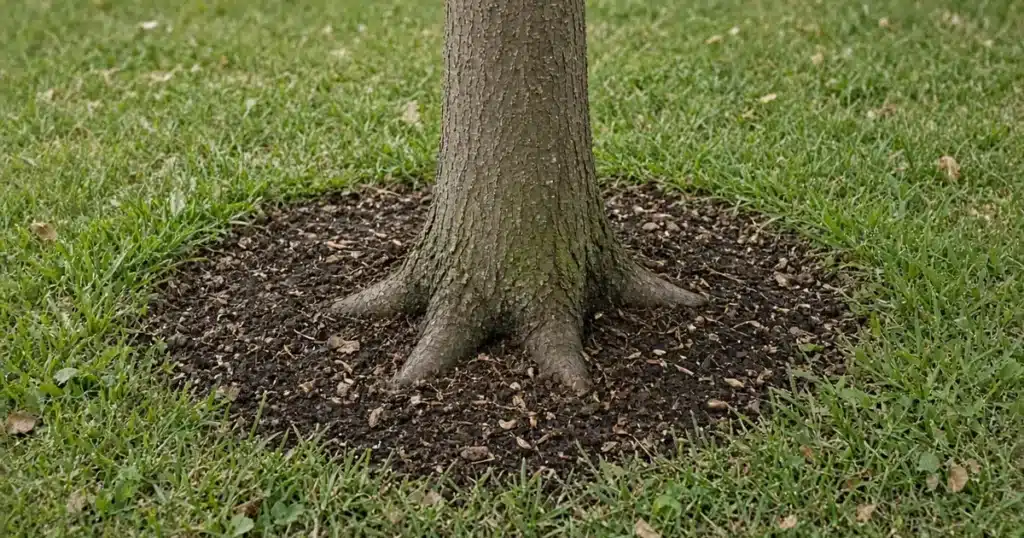
A root flare, also called the trunk flare, is where a tree trunk widens into its main roots. Iowa State and UMass Extension say it should sit at or just above the soil line after planting. Nursery trees often have extra soil over the flare, so remove it until the flare shows before setting depth.
Planting depth is one of the most common tree planting mistakes. A tree set even a few inches too deep may struggle for years. Finding the root flare is the simplest way to get depth right.
What is a root flare?
Look at the base of a mature tree in a forest. The trunk widens as it meets the ground, then splits into large roots that spread outward.
That widening is the root flare, where the trunk ends and the root system begins.
Bark on the trunk is designed to stay dry and exposed to air. Buried bark stays damp and can decay.
The Iowa State University answer on proper tree planting depth explains that the flare should be visible at the soil surface once planting is done.
Why does planting depth matter?
Roots need oxygen. Most feeder roots grow in the top 12 inches of soil, where air reaches them.
Plant a tree too deep and its roots sit below that zone. They struggle, and growth slows.
Deep planting also encourages girdling roots. These roots circle the trunk near the surface and squeeze it as both grow.
The UMass Amherst Extension guidelines for planting trees and shrubs list deep planting as a leading cause of poor tree growth. They recommend setting the flare at or slightly above grade.
| Planting depth | What happens | Long term result |
|---|---|---|
| Flare slightly above grade | Roots get air and water | Healthy growth |
| Flare at grade | Good balance | Healthy growth |
| Flare a few inches deep | Bark stays damp | Slow growth and decay |
| Flare buried deep | Roots starved of air | Girdling roots and decline |
Sources: Iowa State University, UMass Amherst Extension, Colorado State University.
How do you find a buried flare?
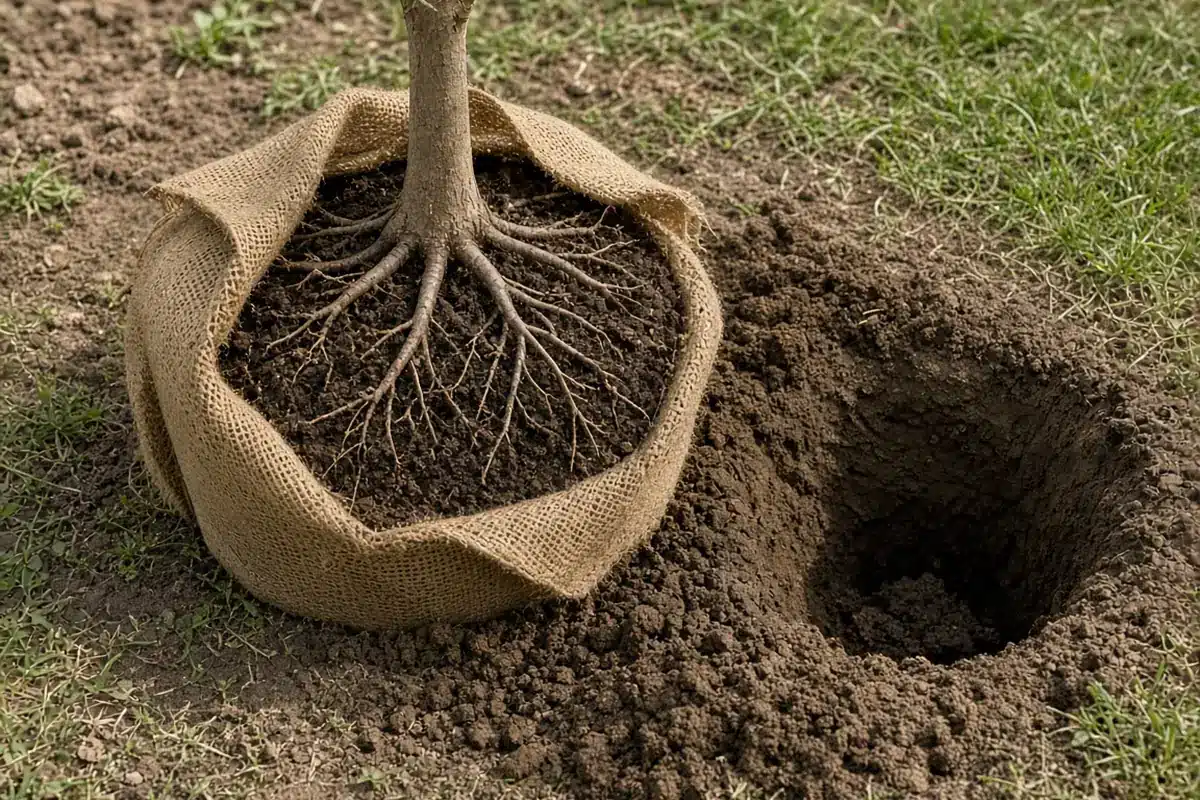
Nursery trees often come with extra soil over the flare. Pots and burlap balls hide it.
Remove the container or open the top of the burlap. Brush soil away from the trunk with your hand or a small tool.
Dig gently until you see the trunk widen and the first large roots appear. This may be two to six inches below the soil line in the pot.
The Colorado State University Extension tree planting steps describe removing excess soil from the top of the root ball until the flare is exposed.
How to: step by step
- Remove the container or wrap.
- Brush away soil at the top of the root ball.
- Find where the trunk widens into roots.
- Dig the hole no deeper than the root ball to the flare.
- Set the flare at or just above grade.
- Pull mulch away from the trunk.
How wide and deep should the hole be?
Dig the hole two to three times as wide as the root ball so roots spread into loose soil.
Measure from the flare to the bottom of the root ball. Dig the hole exactly that deep, or a little shallower.
Set the root ball on firm, undisturbed soil so it does not sink after watering. Our post on soil compaction explains how firm and loose soil affect roots.
Loosen any circling roots on the outside of the root ball. Our post on transplanting covers how to handle root balls gently.
Backfill with the native soil and water slowly to settle it.
How should you mulch a new tree?
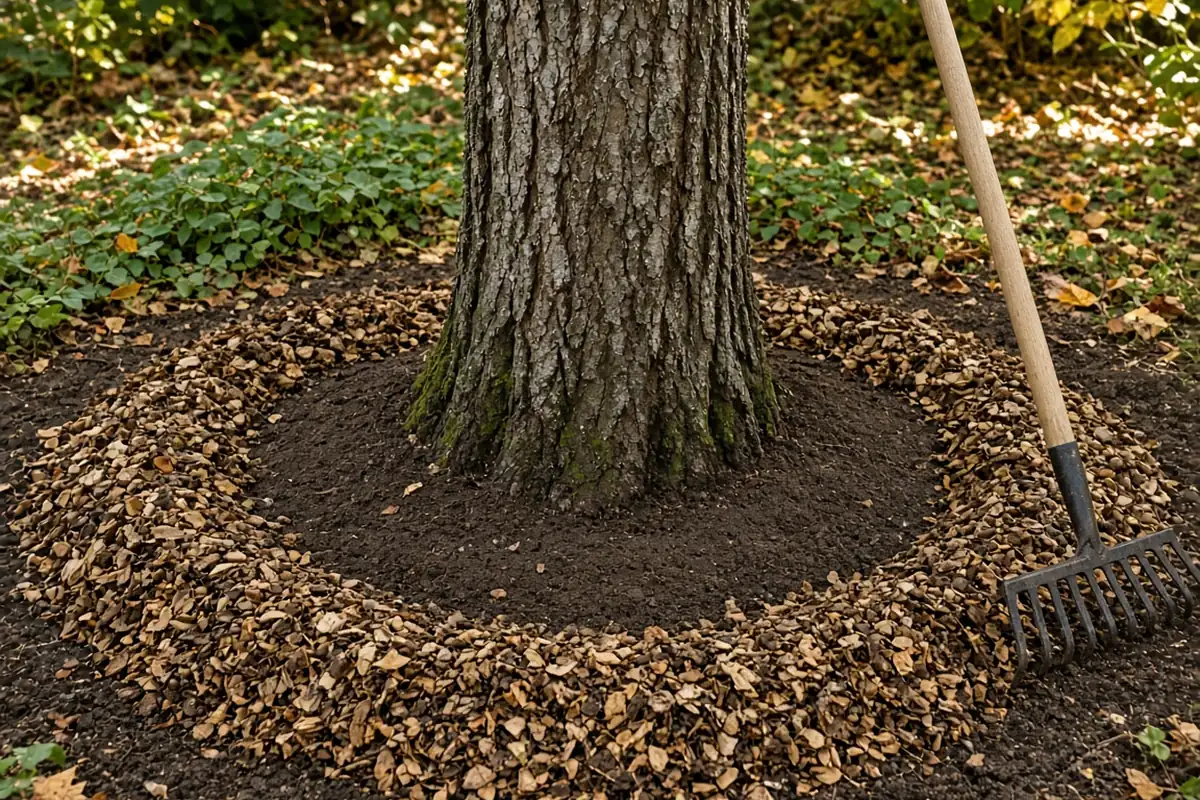
Spread mulch two to three inches deep in a wide ring. Leave a gap of a few inches at the trunk.
Avoid mulch volcanoes, the tall piles of mulch heaped against trunks. They hold moisture against bark just like deep planting does.
Our post on mulch compares types for different uses.
Can you fix a tree planted too deep?
For young trees, yes. Within a year or two of planting, you can often lift the tree and replant it at the right depth.
For older trees, remove extra soil from around the base to expose the flare. Work by hand and avoid cutting large roots.
An arborist can use an air spade to clear soil without harming roots on larger trees.
Troubleshooting
Trunk goes straight into the ground. The flare is buried. Remove soil until it shows.
Tree settles after planting. The hole was dug too deep or loose. Lift and reset on firm soil.
Roots circling the trunk. These may girdle. Cut small ones and consult an arborist for large ones.
Mulch piled on the trunk. Pull it back to show the flare.
Slow growth years later. Check the planting depth first.
A visible flare is the sign of a properly planted tree. Kind Seed Co shares more garden ideas in outdoor growing.
Sources
- What is the proper planting depth for a tree?, Iowa State University Extension, Yard and Garden, What is the proper planting depth for a tree?
- Guidelines for planting trees and shrubs, UMass Amherst Extension Landscape Program, Guidelines for planting trees and shrubs
- Tree planting steps, Colorado State University Extension, Tree planting steps
FAQ
Is root flare the same as trunk flare?
Yes. Both names describe where the trunk widens into roots.
What happens if a tree is planted too deep?
Roots lack air and the tree grows slowly or declines.
Can you fix a deep planted tree?
Young trees can be lifted. Older trees can have soil removed.
Should mulch touch the trunk?
No. Pull mulch a few inches away from the bark.
How wide should a planting hole be?
Dig it two to three times wider than the root ball.



