Ground Ivy in Cannabis Gardens: Creeping Charlie Control

Quick answer: Ground ivy, also called creeping Charlie, is a low perennial in the mint family with square stems, round scalloped leaves and runners that root at each node. University of Maryland Extension says it favors damp, fertile, partly shaded soil. Rake and pull runners from moist soil, remove every piece, fix wet spots and mulch bed edges.
What Is Ground Ivy?
A creeping perennial in the mint family. NC State Extension calls ground ivy an invasive perennial broadleaf weed native to Eurasia. It is an aromatic, evergreen creeper of roadsides, lawns, shady spots and thickets, and it usually grows 1 foot tall or less while branching into a low mat.
University of Maryland Extension says it was introduced to the US in the 1800s or earlier and is a common lawn and garden weed. Both sources use the name creeping Charlie. Our overview of weed control in outdoor cannabis explains why creeping perennials need extra attention.
How Do You Identify Ground Ivy?
Roll a stem between your fingers. Maryland says the stems are square sided, and NC State says the leaves are bright green, rounded and heart shaped with toothed edges. More traits from Maryland:
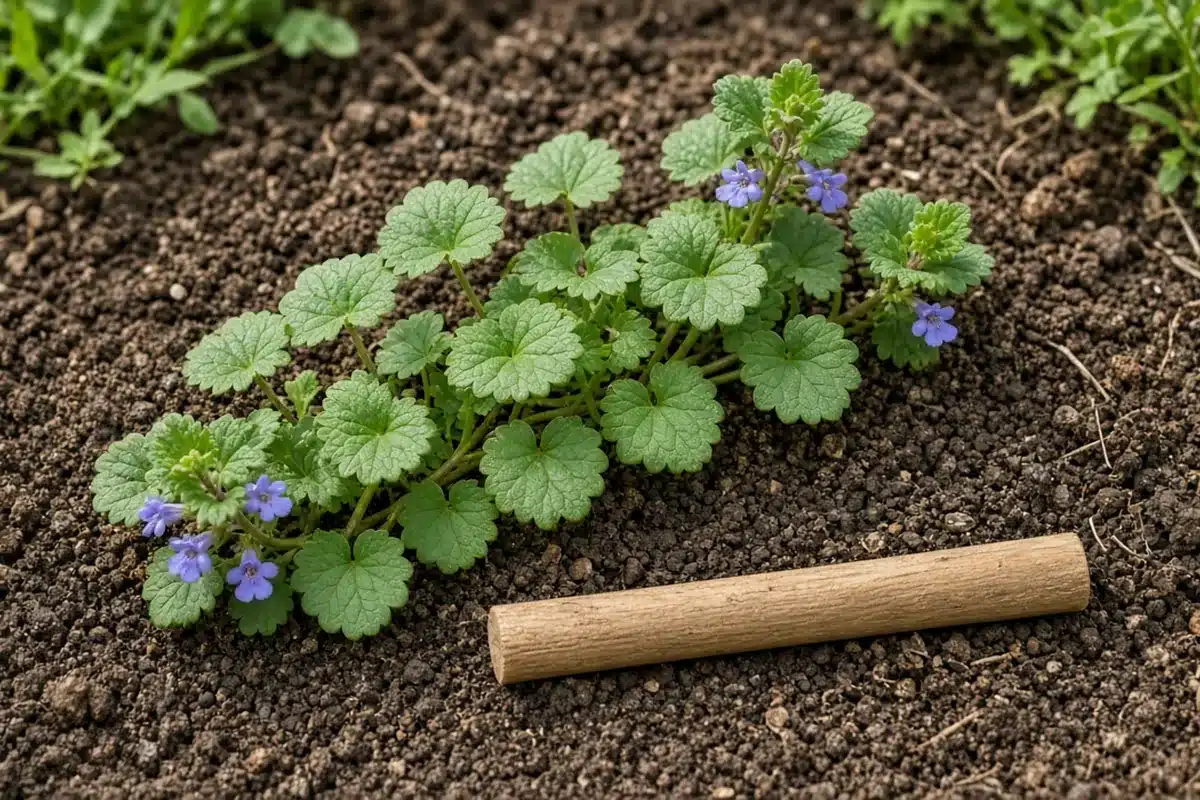
- Scent. Stems and leaves have an unpleasant or minty smell when crushed.
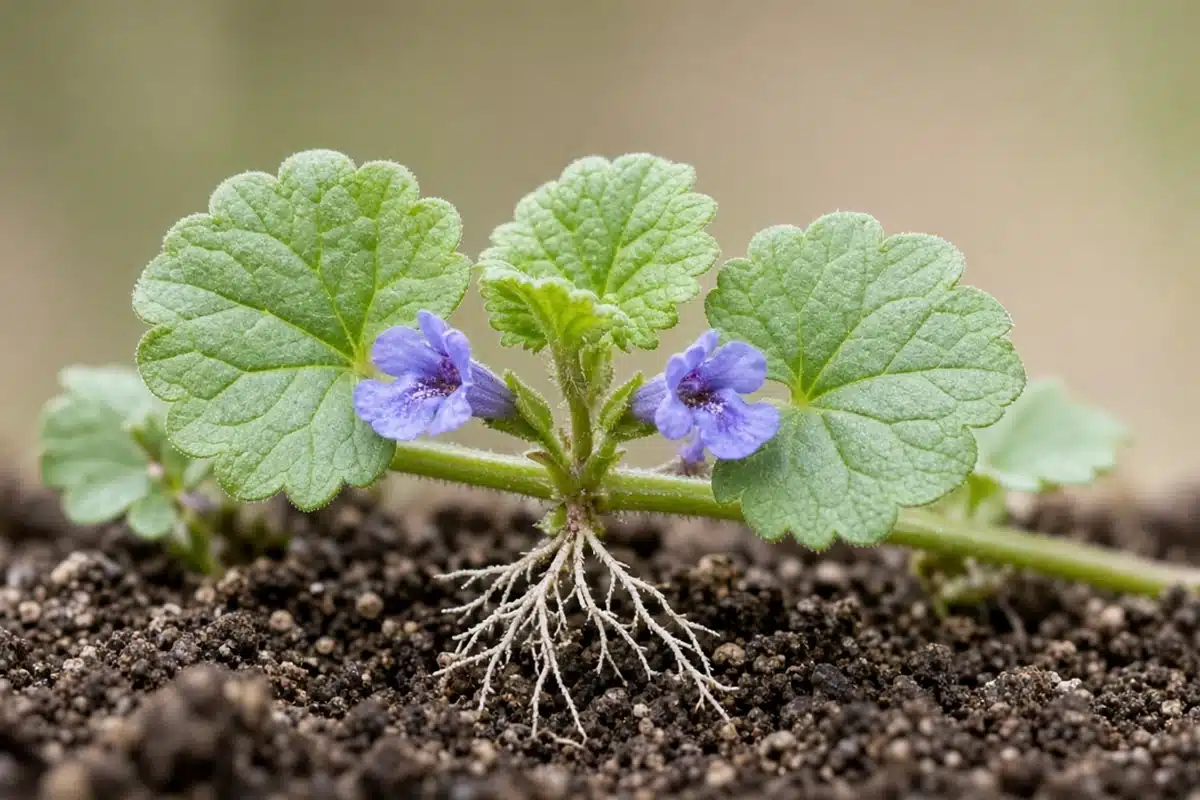
- Leaves. Rounded to kidney shaped, scalloped, set opposite each other, and 0.5 to 1.5 inches across.
- Runners. Stolons creep along the soil surface and root at the nodes.
- Flowers. Light lavender purple or blue purple flowers on short stalks in spring.
- Height. Flowering stems reach only a few inches tall, while runners can grow several feet long.
NC State gives a bloom window of April to June.
How Is Ground Ivy Different From Henbit?
Both are mint family plants with square stems and purple flowers, but they live differently. Ground ivy is a perennial that creeps on rooting runners, as NC State and Maryland describe. Henbit is a winter annual that grows from seed each year. Our guide to henbit in cannabis beds covers that plant.
The runner is the quick test. If a stem lies along the soil and has roots at the leaf joints, you are most likely looking at ground ivy.
Why Does Ground Ivy Spread So Fast?
The runners do most of the work. Maryland says ground ivy grows rapidly, several feet per year, and spreads mainly by runners and less often by seed. NC State says roots form at each leaf node, which helps the plant move across the ground.
That is why a patch at a lawn edge can creep into a bed. NC State adds that hand removal works only if you remove the entire plant. Any piece left behind can reappear.
What Conditions Favor Ground Ivy?
It likes shade and moisture. Maryland says it prefers damp, fertile soil in partly shaded sites, though it can tolerate full sun, and that it does not grow well in very acidic or salt affected soil. NC State says it favors shade, moist conditions and fertile loamy soil where ground cover is thin.
Maryland suggests fixing drainage problems or reducing overwatering that keeps soil constantly moist. Our soil drainage test for cannabis beds helps you find wet spots that invite it.
Can You Pull Ground Ivy by Hand?
Yes, if you start early. Maryland says manual removal is possible but not easy, and is most practical at the start of an infestation. It suggests tugging rooted stems out with a sturdy metal rake, then removing broken pieces by hand or with a small tool. Moist soil makes it easier.
NC State says removing the entire plant is essential, or it will come back. Work slowly along each runner rather than ripping the top off.
Why Is Ground Ivy Easy to Miss in a Lawn?
It hides below the mower blade. Maryland says its low growth habit lets it avoid lawn mower damage, so mowing does little to slow it. The same source notes that patches in a lawn often look lighter, because the flat leaves reflect more light than upright grass blades.
Look for those pale patches along the lawn edge closest to your beds. Catching them there, before the runners reach loose garden soil, is far easier than chasing them between cannabis plants in midsummer.
How to Control Ground Ivy Around Cannabis Beds
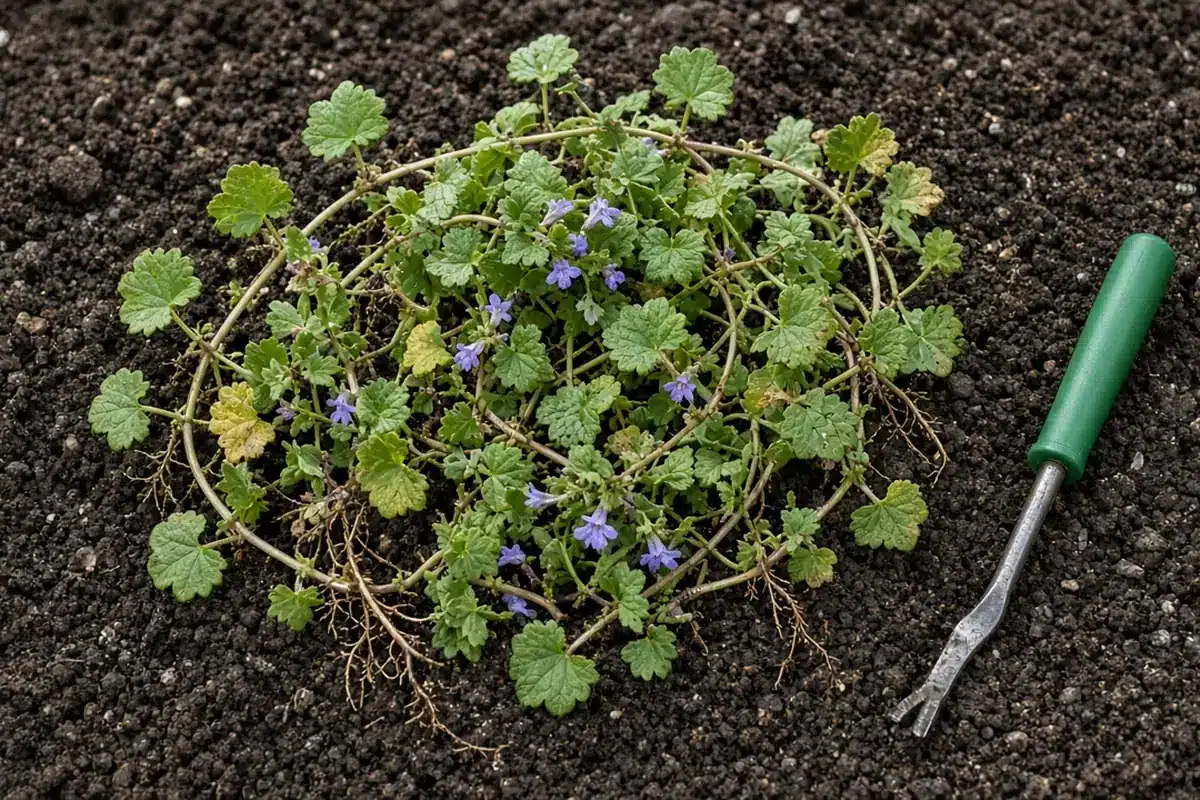
- Find the edge of the patch. Follow runners back to where they root, as Maryland describes.
- Water first if soil is dry. Maryland says rooted stems come out more easily from moist soil.
- Rake out runners. Maryland suggests a sturdy metal rake to tug stems from the soil.
- Pick up every piece. NC State says the whole plant must go or it returns.
- Fix the wet spot. Maryland advises fixing drainage and reducing overwatering.
- Edge the bed. A clear edge between lawn and bed makes runners easier to spot and remove.
- Mulch and recheck often. Keep 3 to 4 inches of mulch on bare soil, as UC IPM recommends. Our guide to mulch for cannabis compares materials.
Ground Ivy at a Glance
| Subject | Extension finding | Attribution |
|---|---|---|
| Life cycle | Perennial, evergreen | NC State |
| Family | Mint family, square stems | NC State, Maryland |
| Spread | Mainly by rooting runners | Maryland |
| Leaf size | 0.5 to 1.5 inches, scalloped | Maryland |
| Bloom period | April to June | NC State |
| Favored site | Damp, fertile, partly shaded soil | Maryland |
Should You Use Herbicides Near Cannabis?
No. Pull, hoe shallowly and mulch. If herbicides ever come up for other parts of your property, follow the label exactly. Remember that EPA has not registered any herbicide for use on marijuana, and state rules vary, so check with your state agriculture department. UC IPM says home gardeners who hand weed and mulch should not need herbicides. Before you plant cannabis outdoors, check your state’s home grow law.
Troubleshooting Ground Ivy
It came back after weeding. NC State says any piece left behind can regrow. Follow each runner and remove it all.
Runners snap off. Maryland says moist soil makes removal easier. Water the day before.
It keeps creeping in from the lawn. Remove runners as they reach the bed.
The patch is in deep shade. Maryland says it prefers partly shaded sites. Open up the area or use a dense ground cover there.
The soil never dries out. Maryland ties it to constant moisture. Fix drainage and cut back watering.
At Kind Seed Co, we keep a clean, firm edge between lawn and cannabis beds.
Frequently Asked Questions
Is ground ivy the same as creeping Charlie?
Yes. NC State Extension and University of Maryland Extension both list creeping Charlie as another name for ground ivy. It is a low, creeping perennial in the mint family with square stems, round scalloped leaves and purple spring flowers. It spreads on runners that root at each leaf joint.
How does ground ivy spread?
Maryland says it spreads mainly by runners and less often by seed, growing several feet per year. NC State says roots form at each leaf node as the stems creep along the ground. That is why a small patch at a lawn edge can creep into a nearby garden bed.
What is the best way to remove ground ivy by hand?
Maryland suggests tugging rooted stems out with a sturdy metal rake, then removing broken pieces by hand or with a small tool. Moist soil makes it easier. NC State says you must remove the entire plant or it will reappear, so follow every runner and pick up all the pieces.
Why does ground ivy grow near my beds?
Maryland says it prefers damp, fertile, partly shaded soil, and NC State says it thrives where ground cover is thin. Shady corners, lawn edges and overwatered spots suit it well. Fixing drainage, reducing extra watering and keeping bare soil covered with mulch make the area less welcoming.
Is ground ivy evergreen?
Yes. NC State calls ground ivy an aromatic, evergreen creeper and a perennial in the mint family, and Maryland Extension notes that its leaves are not shed for winter. The green leaves stay visible after nearby plants die back, so fall and early spring are good times to find patches and rake out runners.
Sources
- NC State Extension Gardener Plant Toolbox, Glechoma hederacea: https://plants.ces.ncsu.edu/plants/glechoma-hederacea/
- University of Maryland Extension, Ground Ivy: https://extension.umd.edu/resource/ground-ivy
- UC Statewide IPM Program, Weed Management in Landscapes: https://ipm.ucanr.edu/home-and-landscape/weed-management-in-landscapes/