
Horseweed in Cannabis Gardens: Spotting and Removal
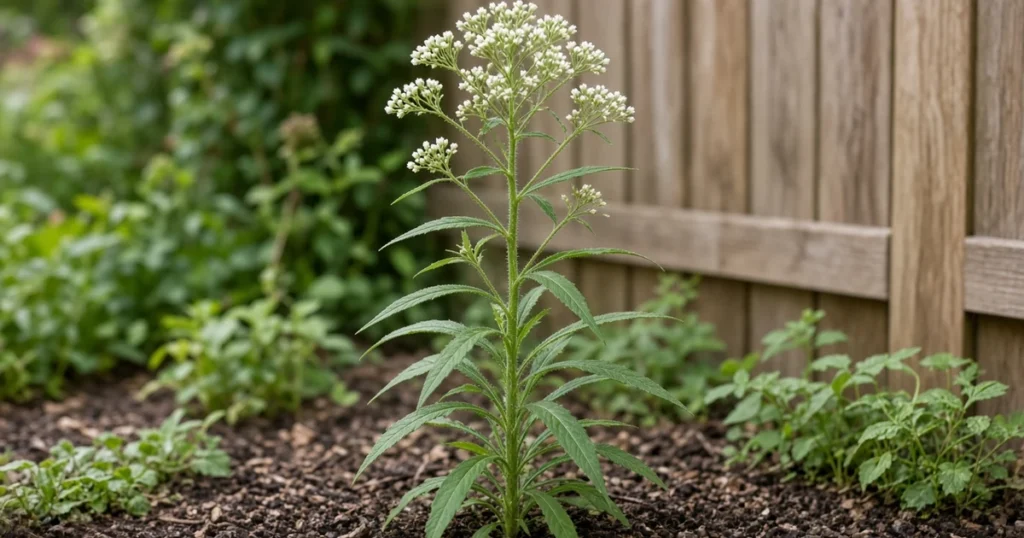
Quick answer: Horseweed, also called marestail, is an annual that usually sprouts in late summer or fall, sits as a flat rosette, then bolts into a stalk up to 10 feet tall. UC IPM calls it a strong competitor for water. Pull rosettes before the stalk forms and never let the fluffy seed heads open over your beds.
What Is Horseweed?
A tall annual broadleaf native to North America. Iowa State University Extension lists it as mainly a winter annual and sometimes a summer annual, found in disturbed areas and no till fields. The University of California Statewide IPM Program (UC IPM) describes it as a summer annual or biennial that settles wherever natural vegetation has been disturbed.
UC IPM adds two points that matter for a cannabis grower. Horseweed grows rapidly, and it is a strong competitor for water. A stand next to a dry summer bed is taking moisture your plants could use. See our post on watering cannabis during drought for dry spell tips. Our overview of weed control in outdoor cannabis covers the wider picture.
How Do You Identify Horseweed?
It changes shape as it grows. Here is what each stage looks like:
- Seedling. UC IPM says seed leaves are oval to egg shaped and only about 1/10 inch long. The first true leaf sits on a hairy stalk, and later leaves are football shaped with slightly toothed edges.
- Rosette. Young plants form a flat ring of leaves around a crown, UC IPM notes. Iowa State says these rosette leaves are hairy, irregularly toothed and 2 to 3 inches long.
- Bolting stalk. Mature plants grow erect, 6 1/2 to 10 feet tall in UC IPM’s description, usually as one main stem that branches in its upper half. Iowa State gives a stem height of up to 6 feet and says the stem is densely crowded with hairy, narrow leaves 3 to 4 inches long.
- Flowers. UC IPM says flowers bloom from June through September as many small heads with an urn shaped green base and a tiny daisylike top.
- Seed heads. These expand into fluffy heads that look somewhat like dandelion puffs, according to UC IPM.
What Looks Like Horseweed?
Hairy fleabane is the closest match. UC IPM says hairy fleabane usually branches near its base, while horseweed’s main stem branches in the upper half. Mowed horseweed can look similar, but UC IPM points to leaf color: horseweed leaves are dark green, while hairy fleabane leaves are gray green. Seed bristles differ too. UC IPM describes horseweed’s as mostly dirty white, and hairy fleabane’s as brownish white and often reddening with age.
When Does Horseweed Sprout?
It mostly sprouts in late summer and fall. Iowa State Extension says that in typical years about three quarters of the population germinates in late summer or fall, and the rest sprouts the next spring.
That timing is actually useful. The fall rosettes sit low and quiet through the cool months, which makes them easy to miss, but also easy to pull. A bed you clean up after harvest is the perfect place to find them. Our guide to fall garden cleanup after cannabis harvest fits naturally with a rosette check.
Why Is Horseweed Seed Such a Problem?
It travels on the wind. Iowa State Extension says the stalk ends in a large cluster of small flowers that produce numerous wind dispersed seeds. UC IPM describes each tiny fruit, about 1/16 inch long, attached to soft, dirty white bristles.
Iowa State also says horseweed can form dense stands where bare ground has no competing plants, and that prolific seed production leads to dense stands of seedlings. Bare, disturbed soil around a new bed is exactly that kind of opening.
Why Not Just Cut the Stalk?
Because it can branch back from the base. UC IPM notes that cutting the main stem of horseweed can lead to the growth of several branches from the base. A cut plant can end up with more seed heads, not fewer. Pulling the whole plant, root and all, avoids that regrowth.
How to Control Horseweed in a Cannabis Bed
- Check beds in fall. Iowa State says most horseweed sprouts in late summer or fall. Walk your beds after harvest and look for hairy, toothed rosettes.
- Pull rosettes by hand. Grab the crown and lift the whole plant. Moist soil makes this easier.
- Check again in spring. Iowa State says the rest of the population sprouts the following spring, so a second sweep before planting catches those.
- Pull, do not cut, bolting plants. UC IPM warns that cutting the main stem can lead to several basal branches. Remove the whole plant instead.
- Bag plants with fluffy heads. UC IPM says seed heads look like dandelion puffs. Bag them carefully so the seeds do not blow across the garden.
- Cover bare soil. UC IPM’s landscape guide says mulch prevents weed seed germination by blocking sunlight, and recommends a medium mulch kept 3 to 4 inches deep. Our guide to mulch for cannabis compares materials.
- Keep competition up. Since Iowa State says horseweed forms dense stands where no other plants compete, avoid leaving cleared ground bare between seasons.
Horseweed at a Glance
| Subject | Extension finding | Attribution |
|---|---|---|
| Life cycle | Mainly winter annual, sometimes summer annual or biennial | Iowa State, UC IPM |
| Main sprouting time | About three quarters in late summer or fall | Iowa State |
| Rosette leaf length | 2 to 3 inches | Iowa State |
| Mature height | 6 1/2 to 10 feet | UC IPM |
| Bloom period | June through September | UC IPM |
| Fruit size | About 1/16 inch with white bristles | UC IPM |
Should You Use Herbicides Near Cannabis?
No. Rely on hand pulling and mulch. No EPA registered herbicide label lists cannabis as a use site, and state rules vary, so check your state agriculture department. UC IPM says herbicides should not normally be needed by home gardeners.
Troubleshooting Horseweed
Rosettes are hard to spot. They sit flat and hairy through winter. Look closely at bare soil in fall and again in early spring, the two times Iowa State gives for sprouting.
A cut plant came back bushier. UC IPM says cutting the main stem can cause several basal branches. Pull the whole plant next time.
New seedlings keep appearing with no parent plant nearby. Iowa State says the seed is wind dispersed. Mulch bare soil and check the edges of your property.
It might be hairy fleabane. UC IPM says horseweed leaves are dark green and fleabane leaves are gray green. Either way, pull it before seed.
A thick stand filled a bare patch. Iowa State says horseweed forms dense stands where nothing competes. Plant or mulch that ground.
For most annual weeds in cannabis beds, hand pulling, hoeing and mulch are enough, and the Kind Seed Co weed guides cover more species.
Sources
- UC Statewide IPM Program, Horseweed, Weed Gallery: https://ipm.ucanr.edu/weeds-identification-gallery/horseweed/
- Iowa State University Extension, Horseweed (marestail): https://crops.extension.iastate.edu/encyclopedia/horseweed-marestail
- UC Statewide IPM Program, Weed Management in Landscapes: https://ipm.ucanr.edu/home-and-landscape/weed-management-in-landscapes/
FAQ
Is horseweed the same as marestail?
Yes. Iowa State Extension notes that horseweed is commonly called marestail, and UC IPM lists mare's tail as another name. It is a tall annual broadleaf native to North America that grows from a low rosette into a single upright stalk with many small flower heads near the top of the plant.
When is the best time to pull horseweed?
Pull it while it is still a rosette. Iowa State says about three quarters of plants sprout in late summer or fall, so a fall check after harvest finds most of them. A second check in spring catches the rest before they bolt into tall stalks and start making their windblown seed.
Can I just cut horseweed down?
Cutting is not a good fix. UC IPM says cutting the main stem of horseweed can lead to the growth of several branches from the base, which can mean more seed heads later. Pulling the whole plant out of moist soil is a more reliable way to remove it from a cannabis bed.
How far can horseweed seed spread?
Iowa State Extension calls horseweed seed wind dispersed, and UC IPM describes each tiny fruit attached to soft bristles. That means seed can drift in from roadsides or empty lots nearby. Mulching bare soil and checking garden edges each season help stop new plants from settling in.


