
Millipedes in Cannabis Pots: Harmless Recyclers or a Problem?
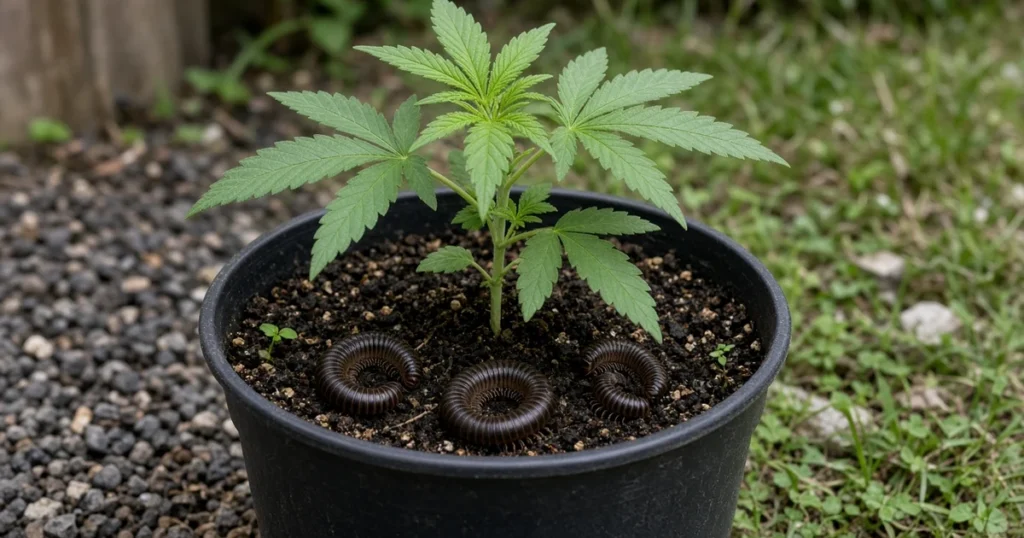
Quick answer: Millipedes in a cannabis pot are usually a sign of damp conditions and decaying organic matter, not a threat to a healthy plant. Iowa State University Extension says millipedes in gardens and potted plants leave plants alone unless they are already injured or rotting. Colorado State University Extension adds that control is rarely needed and should focus mostly on drying things out, since these creatures need moisture to survive.
What Are Millipedes?
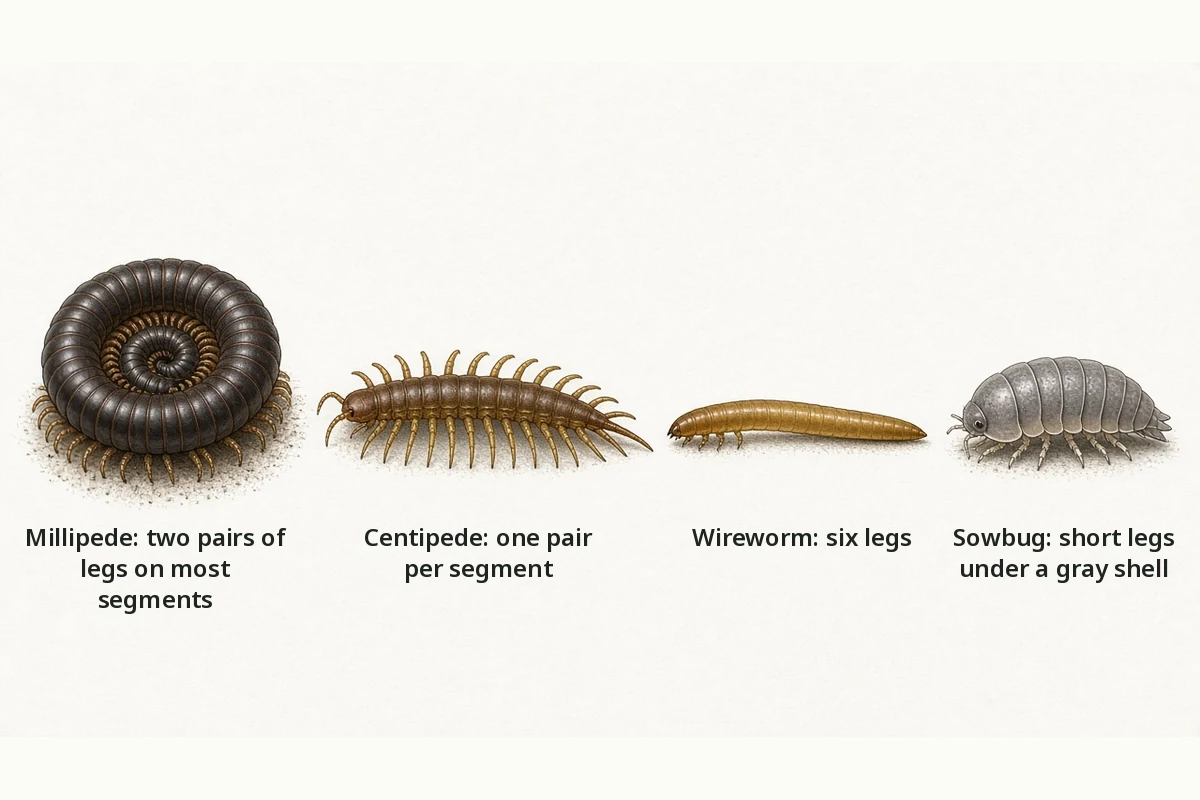
Millipedes are long, segmented arthropods with many short legs. Penn State Extension says they have two pairs of legs on each body segment except the first three, which have one pair each. That is the easiest way to tell them apart from centipedes, which Colorado State says have only one pair per segment.
Iowa State describes the common millipede as about 1 inch long, with a hard, round body that is brown to blackish. Colorado State says the common dark brown kind grows to between 1 and 1 1/2 inches. All three sources note that millipedes curl into a tight coil when disturbed or dead.
Iowa State also describes the garden or greenhouse millipede, often called the flat backed millipede. It is flatter and lighter colored than the common type, with small ridges along the sides of each segment, and Iowa State says it often turns up in potted houseplants.
Do Millipedes Eat Cannabis Roots?
Rarely. Colorado State says millipedes mostly eat decaying leaves and wood, and only rarely chew on tender green growth or roots. Iowa State goes further and says they leave plants alone unless the plant is already damaged or decaying. Iowa State calls them beneficial recyclers that help break down dead material.
Colorado State does note one exception. It lists tender seedlings in greenhouses and gardens as something millipedes may sometimes feed on, along with ripening fruit that rests on the soil. For a cannabis grower, that means young seedlings in very wet trays deserve a closer look, while a large, healthy plant has little to fear.
If roots are actually being chewed, another soil pest may be the cause. Penn State warns not to confuse millipedes with wireworms, which are beetle larvae with only six legs that feed on roots. Our post on wireworms in cannabis soil covers that pest, and symphylans in cannabis soil covers another small root feeder.
Why Are Millipedes in My Cannabis Pot?
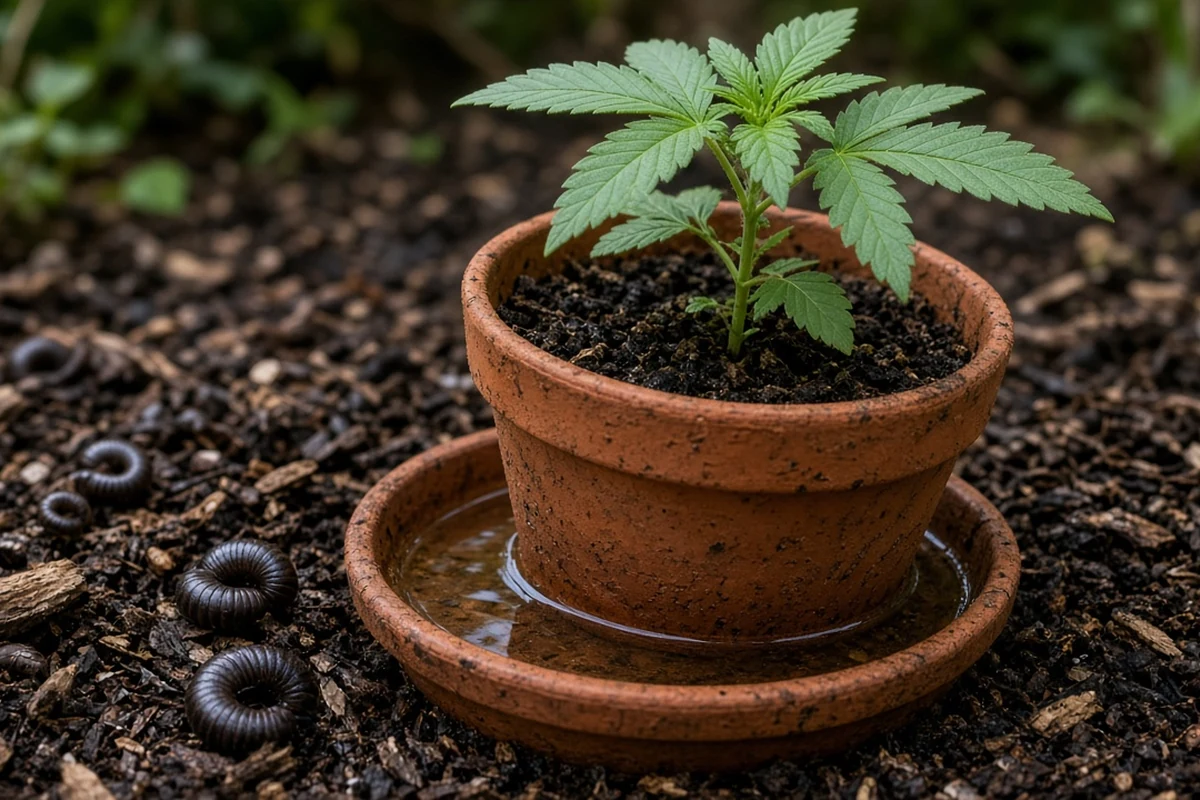
Moisture and organic matter draw them in. Penn State says millipedes live in cool, damp spots under stones, leaf mold, mulch, compost heaps, grass clipping piles and brick paths. Iowa State adds that they hide by day under leaves and plant debris and become most active at night when humidity is higher or dew forms.
A pot that stays wet, sits in a full saucer or has a thick layer of moss or mulch on top offers exactly that habitat. Outdoor containers that rest on damp ground or beside a compost pile can collect wanderers too. Colorado State notes that chronic millipede problems go hand in hand with damp conditions.
How to Identify Millipedes vs Similar Soil Critters
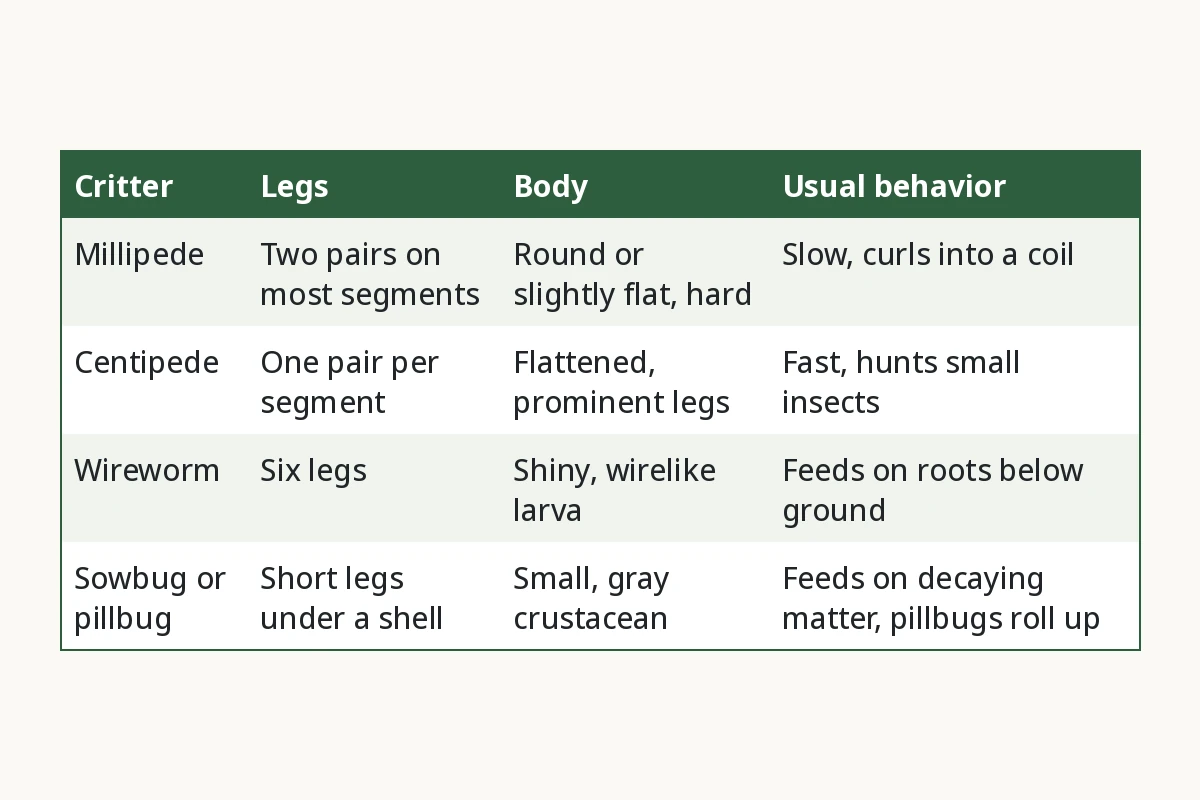
| Critter | Legs | Body | Usual behavior |
|---|---|---|---|
| Millipede | Two pairs on most segments | Round or slightly flat, hard | Slow, curls into a coil |
| Centipede | One pair per segment | Flattened, prominent legs | Fast, hunts small insects |
| Wireworm | Six legs | Shiny, wirelike larva | Feeds on roots below ground |
| Sowbug or pillbug | Short legs under a shell | Small, gray crustacean | Feeds on decaying matter, pillbugs roll up |
Colorado State describes centipedes as much more active than millipedes and as hunters of small insects. Penn State provides the wireworm details. Colorado State notes sowbugs and pillbugs are small gray crustaceans that also favor damp spots. Tiny white jumping creatures in wet mix are another group entirely, covered in our post on springtails in cannabis soil.
Steps to Clear Millipedes From Cannabis Pots
- Confirm what you see. Count the legs per segment and watch whether the creature coils, using the descriptions from Penn State and Iowa State.
- Check the plant first. If the plant is healthy and growing well, Iowa State notes millipedes are not feeding on it.
- Remove surface cover. Iowa State advises taking off soil covering mulch or moss on infested houseplants.
- Let the mix dry more. Iowa State suggests letting potting soil dry as much as the plant can handle between waterings. Our guide to overwatering and cannabis growth explains how to judge that.
- Empty the saucer. Iowa State names the space between pot and saucer as a hiding spot. Pour out standing water after each watering.
- Lift pots off damp ground. Set outdoor containers on bricks or a stand so the base is not resting in wet soil or debris.
- Clean up nearby debris. Penn State and Iowa State both point to leaves, mulch and plant debris as daytime shelter. Rake them away from the grow area.
- Trap and collect outdoors. Colorado State says millipedes gather under fruit rinds or moist newspaper, where they can be picked up and removed.
Should You Use Insecticides on Millipedes?
Usually not. Colorado State says control is rarely needed, and Iowa State calls insecticides of limited benefit because millipedes come from protected places and can travel long distances. Iowa State notes that relying on chemicals alone often disappoints.
For a cannabis plant, drying the mix and removing debris is the safer path. Iowa State mentions houseplant insecticides on the soil surface for persistent cases, but anything applied to a cannabis container must be labeled for that use, and nothing should ever touch the flowers or buds. Moisture control alone often solves the problem, according to Colorado State.
When Do Millipedes Show Up the Most?
Spring and fall. Colorado State says millipedes move most in September and October, and again in the middle of spring, often right after wet weather. Penn State links these migrations to cooler weather and heavy rains. Iowa State adds that millipedes may wander in from woods or fields 50 feet or more away.
Colorado State says these influxes often stop as suddenly as they start. If your outdoor pots suddenly have many millipedes after a rainy week, a few dry days and some cleanup usually ends it.
Can Millipedes Live in an Indoor Grow?
Not for long, in most cases. Iowa State says millipedes cannot reproduce indoors and that any millipede found inside got there by accident. Penn State notes they survive only a few days in the dry air of most buildings, and Colorado State says they usually die within a day or two.
Iowa State does note an exception for greenhouses, where the flat backed millipede can be abundant. A humid grow tent with wet trays and moss topped pots can act like a small greenhouse. To find the source, Iowa State suggests checking under benches, in plants and in other damp spots. For indoors, sweeping or vacuuming up the wanderers is the most practical fix, as Iowa State recommends.
Troubleshooting Millipedes
Millipedes return after every watering. The mix is likely staying wet for too long. Water less often and let the mix dry as far as the plant tolerates, the approach Iowa State suggests.
Seedlings look chewed at the stem. Colorado State says millipedes may feed on tender seedlings. Check at night with a flashlight, since Iowa State notes they are most active then, and look for other pests such as slugs or cutworms.
Millipedes are under the weed barrier near the grow. Penn State says millipedes thrive in gravel or mulch laid over plastic sheeting, and that removing the barrier lets the soil dry and warm.
You see hundreds after a storm. That fits the migrations Colorado State and Penn State describe. Wait a few days, then clear the bodies.
The root zone smells sour. Decay in the pot may be feeding the millipedes. Check roots for rot and improve drainage.
Houseplants nearby are full of millipedes. Iowa State says you may choose to discard badly infested houseplants. Move them away from your cannabis plants first.
Sources
- Colorado State University Extension, Millipedes, Centipedes, and Sowbugs: https://extension.colostate.edu/resource/millipedes-centipedes-and-sowbugs/
- Iowa State University Extension and Outreach, Yard and Garden, Millipedes: https://yardandgarden.extension.iastate.edu/encyclopedia/millipedes
- Penn State Extension, Millipedes: https://extension.psu.edu/millipedes
FAQ
Are millipedes good for soil?
Yes, mostly. Iowa State calls them beneficial recyclers that break down decaying organic matter.
Do millipedes bite?
No. Colorado State says millipedes cannot bite and are no danger to people, and Iowa State adds that they cannot sting.
Why do millipedes curl up?
Curling is a defense posture. Colorado State and Iowa State both say they coil when disturbed or handled, and they stay coiled after death.
Can millipedes kill a cannabis plant?
It is unlikely. Iowa State says they only feed on plants that are already injured or breaking down.
Will repotting get rid of millipedes?
It can help if the old mix is soggy. Fresh, well drained mix and a clean pot remove the damp, decaying material they favor.
Do millipedes mean my soil is bad?
Not necessarily. They point to moisture and organic matter, which can be normal in compost rich mixes. Focus on drainage and watering habits.


