
Urban Permaculture: Small Space Design for City Yards
The short answer
Urban permaculture applies permaculture design to small city yards, patios and shared spaces. UMass and Oregon State Extension describe observing your site, catching water, building soil and stacking plants in layers. In a city lot, start small with herbs near the door, a compost bin and a rain barrel.
Permaculture is often pictured on large rural farms, but its ideas work just as well on a city lot, a rooftop or a balcony. Small spaces even make some principles easier to apply.
What is urban permaculture?
Permaculture is a design approach that models gardens on natural systems. The goal is a garden that feeds you and itself, requiring less outside input over time.
The UMass Amherst permaculture fact sheet describes permaculture as a way of designing with nature. It uses careful observation, diverse plantings and closed loops of water and nutrients.
On a city lot, space is limited, so every plant and feature should do more than one job.
How do principles fit small spaces?
The Oregon State University Extension guide to permaculture basics highlights core principles for home gardeners.
| Principle | City yard example |
|---|---|
| Observe and interact | Track sun, shade and wind for a full year |
| Catch and store energy | Rain barrels, water harvesting swales |
| Obtain a yield | Herbs, greens and fruit in every bed |
| Produce no waste | Compost kitchen scraps and leaves |
| Use edges | Plant along fences, walls and paths |
| Stack functions | A trellis that gives shade, privacy and beans |
| Use small, slow solutions | Expand one bed at a time |
Sources: UMass Amherst Extension, Oregon State University Extension, NC State Extension.
How do zones work in a small yard?
Permaculture zones arrange a site by how often you visit each area.
Zone 0 is the house. Zone 1 sits right outside the door, so put herbs, salad greens and anything you pick daily there.
Zone 2 holds larger vegetable beds, compost and small fruit. Zone 3 in a city lot may be a few fruit trees or berry bushes along the back fence.
Most city yards stop at zone 2 or 3, and that’s fine. Planning by visit frequency still saves steps.
The NC State Extension Gardener Handbook appendix on permaculture design explains zones and sectors in more detail.
What are good first projects?
A kitchen herb bed near the door for daily use.
A compost system that turns kitchen and yard scraps into soil. Our post on composting garden waste covers bin types.
A keyhole bed. A round raised bed with a compost basket in the center. Our post on keyhole gardens shows how to build one.
Square foot beds. Grid planting packs more food into a small area. Our post on square foot gardening explains the layout.
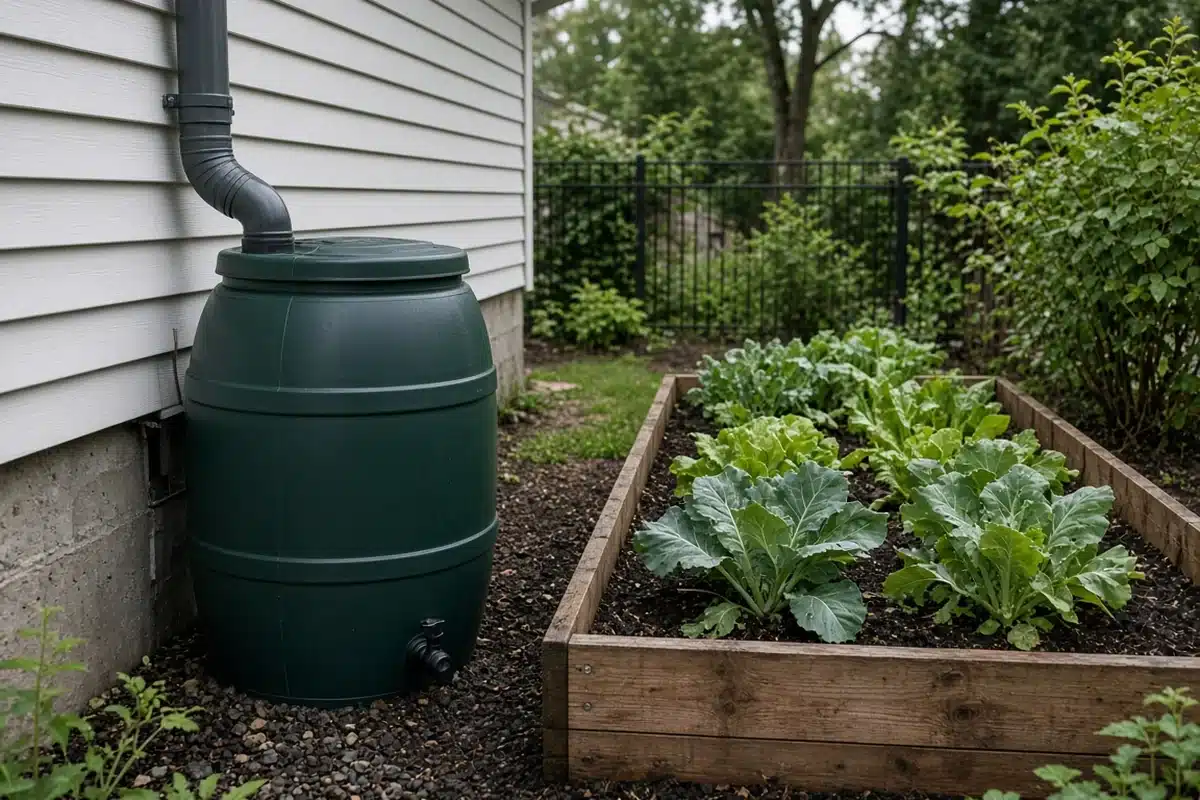
A rain barrel to catch roof water for dry spells.
A pollinator strip. Native flowers along a fence bring bees and other helpful insects.

How to: step by step
- Observe sun, wind and water on your site.
- Plan where rain barrels and compost fit.
- Place herbs and greens near the door.
- Add compost to build soil.
- Stack plants in layers where space allows.
- Expand projects one season at a time.
What is a food forest?
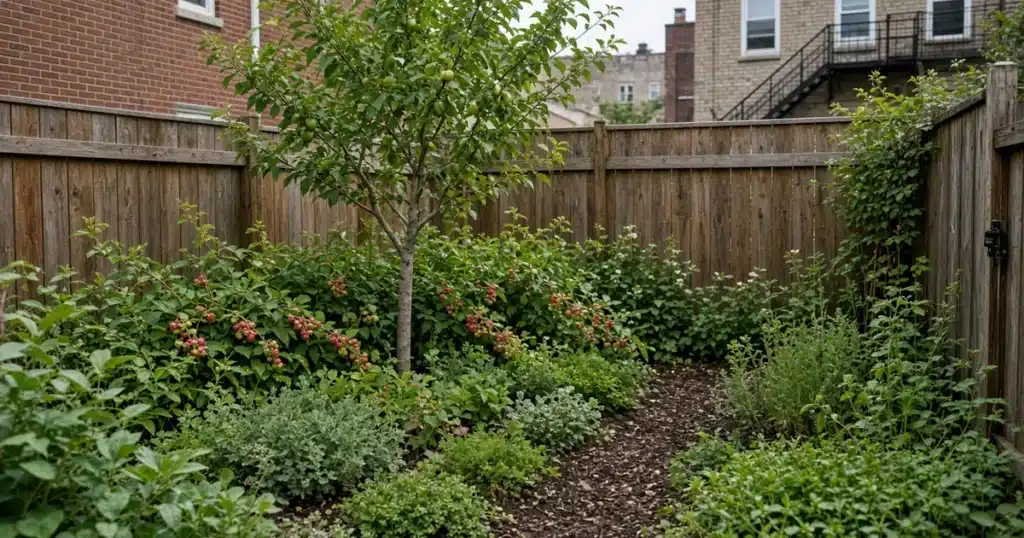
A food forest layers plants like a natural woodland. Tall fruit trees form the canopy, with shrubs, herbs, ground covers and vines below.
In a city yard, a mini food forest might be one dwarf apple with currants, herbs and strawberries underneath. A grape or bean vine can climb a nearby fence.
Choose compact varieties to hold layers in scale with a small space.
Can you practice permaculture on a balcony?
Yes. Layer containers with taller plants at the back and trailing herbs at the edges.
Compost with a worm bin. Catch water from a downspout or reuse cooking water once cooled.
Group pots by water needs to save effort.
How do neighbors fit in?
Permaculture values shared resources, so swap seeds, cuttings and surplus harvest with neighbors.
Community gardens and shared yards stretch what a single lot can do.
Troubleshooting
Not enough sun. Grow leafy greens and herbs that tolerate shade.
Soil poor or compacted. Build raised beds and add compost each season.
Too many projects at once. Finish one before you start the next.
Rain barrel overflowing. Add a diverter or a second barrel.
Pests in a dense planting. Add flowers that support beneficial insects.
A small city lot can become a productive, living system one bed at a time. Kind Seed Co shares more garden ideas in outdoor growing.
Sources
- Permaculture fact sheet, UMass Amherst Extension, Permaculture fact sheet
- Permaculture basics for Master Gardeners, Oregon State University Extension, Permaculture basics for Master Gardeners
- Extension Gardener Handbook, appendix G: permaculture design, NC State Extension, Extension Gardener Handbook
FAQ
Can you practice permaculture on a balcony?
Yes. Layer containers and compost with a worm bin.
What is a food forest?
A garden that layers trees, shrubs, herbs and ground covers like a woodland.
Where should a rain barrel go?
Set it under a downspout, close to the beds it will water.
How do zones work in a small yard?
Place what you visit most closest to the door.
What is a good first project?
A kitchen herb bed or a compost bin near the house.



