Curly Dock in Cannabis Gardens: Wet Spots and Taproots
Quick answer: Curly dock is a perennial broadleaf with long, wavy edged leaves, a stout taproot and rusty brown seed stalks. UC IPM links it to overwatering and standing water. Dig out young plants with the whole root, cut seed stalks before the seed matures, and check for wet spots it may be using.
What Is Curly Dock?
A long lived perennial in the buckwheat family. NC State Extension calls curly dock a long lived perennial weed that grows in full sun on moist to dry sites and tolerates most soils. It withstands drought, temporary flooding and occasional mowing.
The University of California Statewide IPM Program (UC IPM) says curly dock usually grows in wet areas and is frequently associated with overwatering or standing water in low areas. Its habitat list includes ditches, roadsides, pastures and disturbed moist places. Our overview of weed control in outdoor cannabis explains why perennial weeds should come out first.
How Do You Identify Curly Dock?
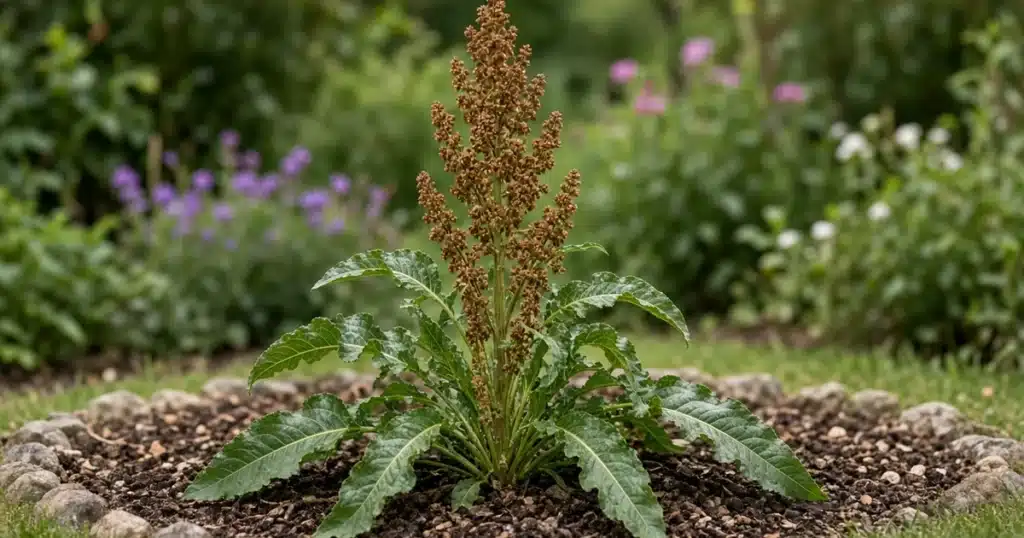
Look at the leaf edge. NC State says the leaves have very wavy margins and form a basal rosette about 1 foot across. Other features:

- Stem leaves. About 6 inches long and 1 inch wide, oblong and lance shaped, per NC State.
- Height. UC IPM says plants grow 2 to 5 feet tall.
- Leaf sheath. UC IPM notes a membranous sheath at the leaf base and swollen stem joints, typical of the buckwheat family.
- Flowers. Green, non showy flowers in whorls along the upper stem.
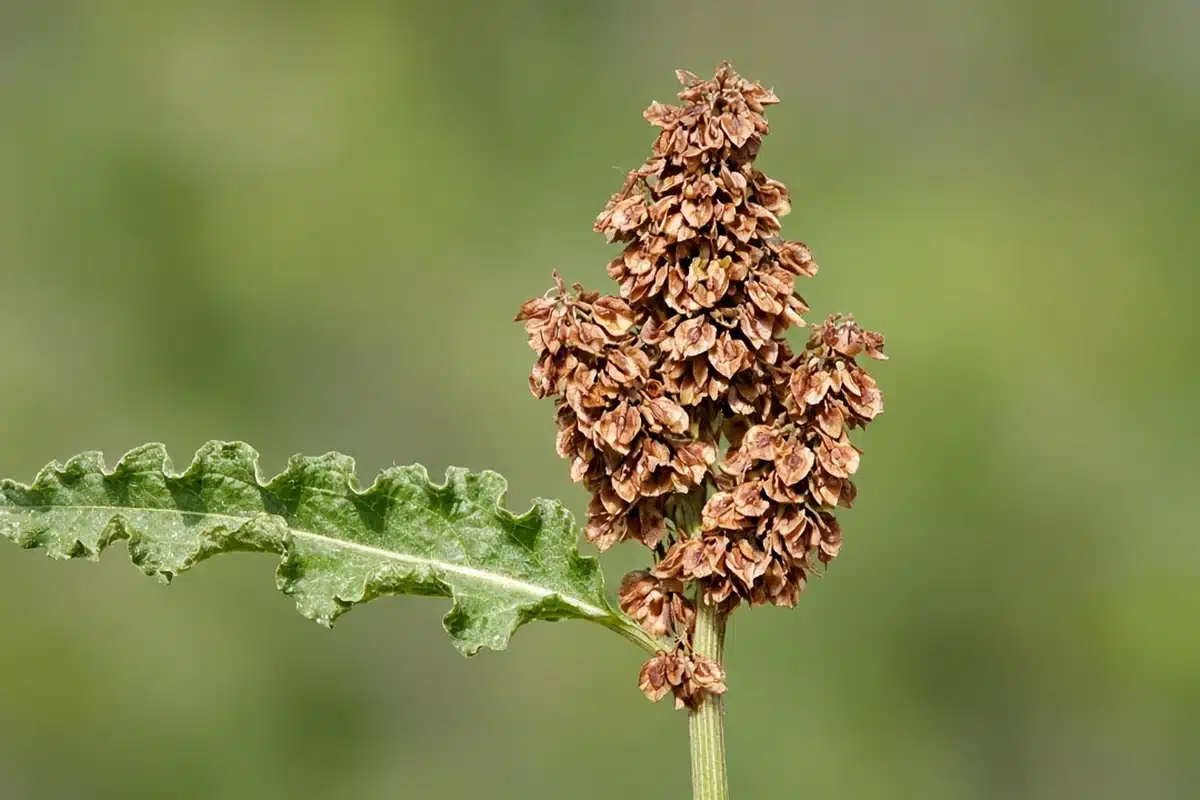
- Seed stalks. UC IPM says the fruiting stem dies back in mid to late summer and turns a distinctive rusty brown.
- Seed. Triangular, smooth, glossy reddish brown seeds in papery three winged covers.
Seedlings can be green or red tinged in cool months, UC IPM adds.
Does Curly Dock Point to Wet Soil?
Often, but not always. UC IPM ties curly dock to overwatering and standing water, and to disturbed moist places. If you find a patch near a drip line leak, a low corner or a downspout, check for overwatering or standing water, though its presence alone does not prove a drainage problem.
Where the soil does stay wet, fixing the water helps along with pulling. Our soil drainage test for cannabis beds shows how to check whether a bed drains well enough for cannabis roots, which dislike soggy soil too.
How Long Does Curly Dock Seed Last?
For a very long time. NC State says the seeds of curly dock can remain viable for up to 50 years. UC IPM adds that seed can travel on wind and water. Once a plant drops seed, the bed may carry that seed for decades.
That makes the seed stalk the main target. UC IPM says the fruiting stem dies back in mid to late summer and turns rusty brown. Cut and bag seed stalks early, before the seed matures. Clearing old stalks is also part of a good fall garden cleanup after cannabis harvest.
How Is Curly Dock Different From Red Sorrel?
Size and leaf shape. UC IPM says curly dock has stout stems, while red sorrel has slender red stems. Curly dock leaves are lance shaped, and red sorrel leaves are arrow shaped. The flower parts attached to curly dock fruit can be toothed or carry small bumps, while red sorrel’s do not.
Both are in the buckwheat family and both like disturbed ground. Getting the ID right tells you whether you are dealing with a deep taproot, as with curly dock, or a spreading root system.
Is Curly Dock Harmful to Pets?
It can be, though the risk is rated low. NC State lists curly dock as a problem for dogs, cats and horses and gives a low poison severity, with soluble calcium oxalates as the cause. UC IPM says plants may be poisonous to livestock when eaten in quantity.
Keep it out of areas where pets dig or graze, and bag pulled plants rather than leaving them in piles. Call your vet if a pet eats it, and clear it from garden paths and bed edges.
How to Control Curly Dock in a Cannabis Garden

- Find the wet spots. UC IPM links curly dock to overwatering and standing water. Check drip lines and low corners.
- Dig young plants. UC IPM’s landscape guide says to use a dandelion knife or similar tool to remove all roots of perennial weeds.
- Work in moist soil. Taproots come out more fully when the soil is soft.
- Cut seed stalks early. Remove them before the seed matures and bag them.
- Bag the seed. NC State says seed can stay viable for up to 50 years.
- Fix the drainage. Repair leaks, redirect downspouts and avoid overwatering.
- Mulch cleared ground. Keep 3 to 4 inches of mulch over bare soil, as UC IPM recommends. Our guide to mulch for cannabis compares materials.
Curly Dock at a Glance
| Subject | Extension finding | Attribution |
|---|---|---|
| Life cycle | Long lived perennial | NC State, UC IPM |
| Height | 2 to 5 feet | UC IPM |
| Leaf | Lance shaped with very wavy edges | NC State, UC IPM |
| Favored site | Wet, overwatered areas | UC IPM |
| Seed life | Viable up to 50 years | NC State |
| Mature seed stalk | Rusty brown by mid to late summer | UC IPM |
Should You Use Herbicides Near Cannabis?
No. Pull, hoe shallowly and mulch. If herbicides ever come up for other parts of your property, follow the label exactly. Remember that EPA has not registered any herbicide for use on marijuana, and state rules vary, so check with your state agriculture department. UC IPM says home gardeners who hand weed and mulch should not need herbicides. Before you plant cannabis outdoors, check your state’s home grow law.
Troubleshooting Curly Dock
It regrows after pulling. The taproot broke. Dig deeper with a weeding knife when soil is moist.
Patches return in the same corner. UC IPM ties curly dock to standing water. Check for standing water there and fix it if you find it.
Brown seed stalks are everywhere. UC IPM says stalks brown in mid to late summer. Cut and bag them earlier next year.
Seedlings keep sprouting. NC State says seed can last up to 50 years. Mulch and pull seedlings every year.
Pets chew the leaves. NC State lists it as a problem for dogs, cats and horses. Remove plants from pet areas.
At Kind Seed Co, we read weeds like curly dock as clues to what the soil needs.
Frequently Asked Questions
Is curly dock a perennial?
Yes. NC State Extension calls curly dock a long lived perennial weed in the buckwheat family. UC IPM also lists it as a perennial broadleaf. It grows from a stout taproot and forms new rosettes each year, so pulling the top alone usually fails. Dig out the root to remove it.
Why does curly dock grow in my garden?
UC IPM says curly dock usually grows in wet areas and is often linked to overwatering or standing water in low spots. It also tolerates drought, flooding and mowing, according to NC State. Look for leaks, low corners and soggy soil where it appears, and fix any water problem you find along with removing plants.
How long do curly dock seeds survive?
NC State says curly dock seeds can remain viable for up to 50 years. UC IPM adds that the seed spreads on wind and water. That long life is why stopping seed matters so much. Cut and bag seed stalks early, before the seed matures.
How do I tell curly dock from red sorrel?
UC IPM says curly dock has stout stems and lance shaped leaves, while red sorrel has slender red stems and arrow shaped leaves. The flower parts on curly dock fruit can be toothed or bumpy, but red sorrel’s are not. Both belong to the buckwheat family and like disturbed ground.
Can I mow curly dock instead of digging it?
Mowing alone is unlikely to clear it. NC State says curly dock is a long lived perennial that withstands drought, temporary flooding and occasional mowing. UC IPM’s landscape guide says to use a dandelion knife or similar tool to dig up all roots of perennial weeds, so lift the taproot instead.
Sources
- UC Statewide IPM Program, Curly Dock, Weed Gallery: https://ipm.ucanr.edu/weeds-identification-gallery/curly-dock/
- NC State Extension Gardener Plant Toolbox, Rumex crispus: https://plants.ces.ncsu.edu/plants/rumex-crispus/
- UC Statewide IPM Program, Weed Management in Landscapes: https://ipm.ucanr.edu/home-and-landscape/weed-management-in-landscapes/