
Removing Water Sprouts on Fruit Trees: When and How to Prune Them
The short answer
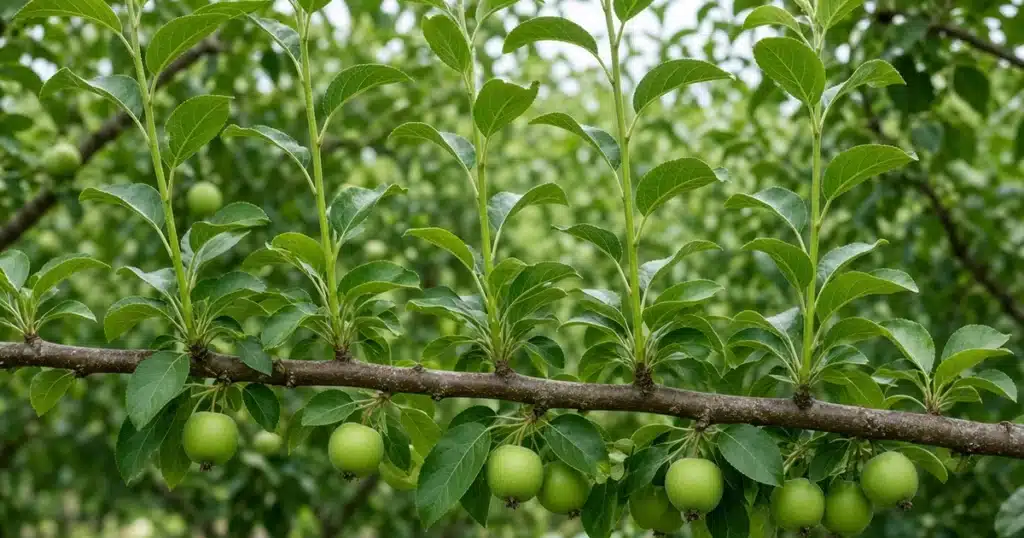
Removing water sprouts holds a fruit tree canopy open, since these upright shoots shade the tree and rarely fruit well. Rub off small green sprouts by hand. Cut larger ones just outside the branch collar without leaving stubs. Summer removal slows regrowth, and big cuts tend to trigger more sprouts.
Water sprouts often follow hard pruning or storm damage. Knowing why they form makes them much easier to manage.
What are water sprouts?
Water sprouts are vigorous shoots that grow straight up from the upper side of branches. They often appear in clusters, mainly near pruning cuts. In a single season, they can grow several feet.
They differ from suckers, which grow from roots or from the rootstock below the graft. Both are unwanted in most fruit trees.
The Purdue Extension Master Gardener illustrated glossary of plant identification terms defines shoot, node and bud terms that help you describe where sprouts emerge.
| Term | Where it grows | Notes |
|---|---|---|
| Water sprout | Upper side of branches | Upright, fast, rarely fruits well |
| Sucker | Roots or rootstock below the graft | Remove at the source |
| Spur | Short shoots on older wood | Bears fruit for years |
| Lateral branch | Side branch off a main limb | Forms the fruiting framework |
Sources: UC ANR, Oregon State University Extension, Purdue Extension.
Why do they form?
Heavy pruning removes many branches, but the root system stays the same size. The tree often answers by waking dormant buds and sending up fast shoots.
The UC ANR publication on training and pruning deciduous fruit trees explains that heavy dormant pruning stimulates vigorous upright growth. Large cuts, mainly heading cuts that shorten big limbs, trigger the most sprouts.
Other causes include sudden sun exposure on bark after limbs are removed, storm damage and branches bent too far below horizontal.
Can water sprouts bear fruit?
Rarely well, since they grow too fast and upright to form many flower buds. Their fruit, when it comes, tends to be poorly placed and shaded.
In a few cases, a sprout can be trained to fill a gap where a branch was lost. Bend it toward a more horizontal angle with a spreader or tie. Over a few years, it may form spurs and bear.
Our post on low stress training for cannabis shows how bending shoots changes growth, the same idea used when training a sprout into a branch.
How should you remove them?
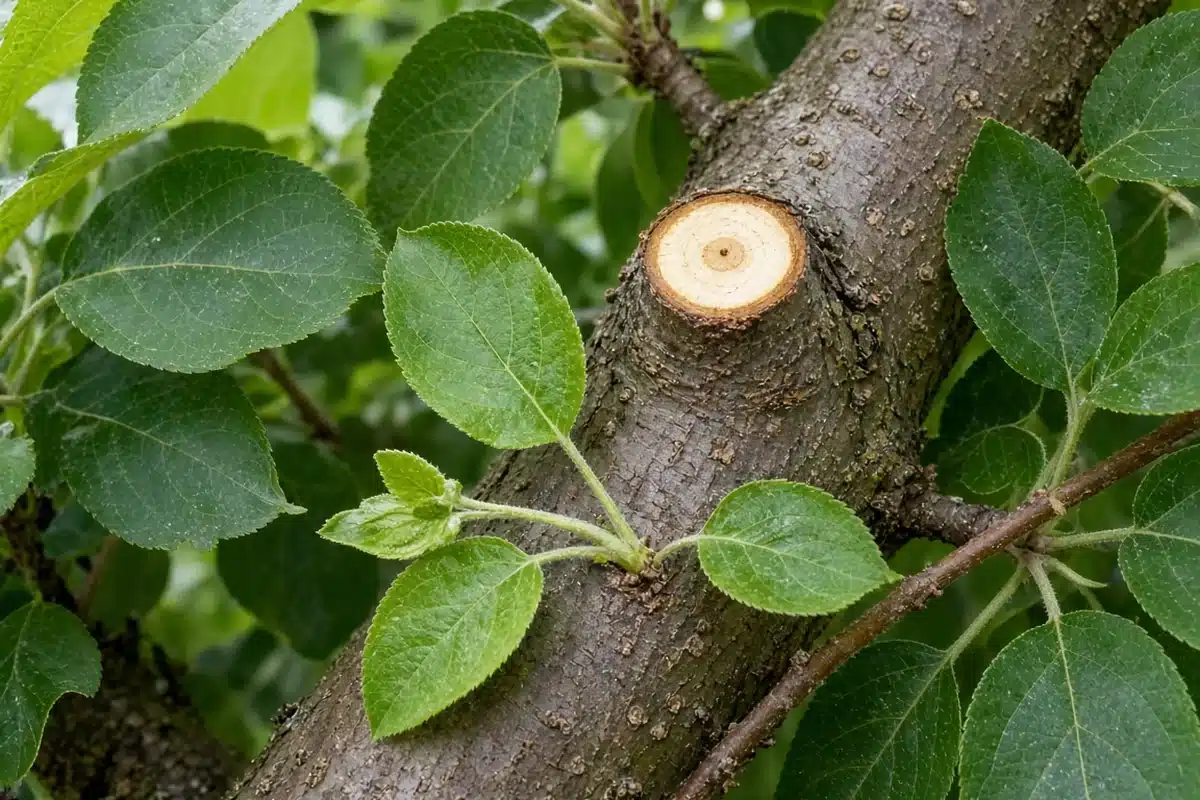
Cut water sprouts just outside the branch collar where they join the branch. Don’t leave stubs.
Rub or snap off small sprouts by hand while green and soft. It’s the easiest method and leaves the smallest wound.
The Oregon State University Extension guide to training and pruning your home orchard recommends removing most water sprouts each year and saving only the few needed to fill gaps.
Use sharp, clean tools. Our post on sanitizing pruning shears for cannabis covers simple cleaning between trees.
When should you remove them?
Summer is ideal. Removing sprouts in summer slows regrowth, because the tree has less time to respond before dormancy. Late spring to midsummer, when sprouts are still small, works well.
Dormant season removal is fine too, but it may trigger more sprouts the next spring.
How do you prevent them?
Prune lightly every year rather than heavily every few years. Use thinning cuts that remove a branch back to its origin rather than heading cuts that shorten it.
Hold the tree in balance. Avoid excessive fertilizer, which can push extra shoot growth.
Our post on pruning marijuana plants covers thinning and heading cuts that apply to many plants.
How do sprouts affect the canopy?
Sprouts shade the inner canopy. Fruit in shade colors poorly and sets fewer flower buds for next year. Leaves may stay wet longer, which can raise disease risk.
Removing sprouts opens the canopy to light and air.
How do you train a sprout to fill a gap?
Pick a sprout near the gap with good placement. Remove the others around it.
Bend it toward a more horizontal angle with a clothespin when small, or a spreader or tie when larger. Upright shoots continue growing fast. Flatter shoots slow down and form flower buds.
After a year or two, remove the spreader. The branch should hold its new angle and start forming spurs.
How to: step by step
- Spot upright shoots on top of branches.
- Cut them off at the branch collar.
- Thin them in summer when possible.
- Avoid heavy dormant pruning.
- Save a few only to fill gaps.
- Check the canopy for light each year.
Walk your trees in early summer and rub off green sprouts by hand.
Troubleshooting
Many sprouts after pruning. Cuts were heavy. Prune lighter.
Shady canopy. Sprouts were left. Remove most.
Sprouts regrow. Pruning was heavy. Prune lighter each year.
Sprouts on one limb. That limb was cut back hard. Use thinning cuts.
Sprouts at the base are often suckers. Remove them where they start.
With light, steady pruning, water sprouts become a small summer chore. Kind Seed Co shares more garden projects in outdoor growing.
Sources
- Fruit trees: training and pruning deciduous trees (Pub 8057), UC ANR, Fruit trees
- Training and pruning your home orchard (PNW 400), Oregon State University Extension, Training and pruning your home orchard (PNW 400)
- Plant identification terminology: an illustrated glossary, Purdue Extension Master Gardener Program, Plant identification terminology
FAQ
Are water sprouts the same as suckers?
No. Water sprouts grow from branches. Suckers grow from roots or rootstock.
Can water sprouts bear fruit?
Rarely well. A few can be trained to fill gaps.
When should you remove them?
Summer, when they are small. Regrowth is slower.
Why does pruning cause water sprouts?
Heavy cuts remove many branches while roots stay the same, so the tree often pushes new shoots.
Can I snap them off by hand?
Yes, when they are small and green.



