
What Is a Vascular Bundle? The Plumbing Strands in Stems and Leaves
The short answer
A vascular bundle is a strand that pairs xylem and phloem, the tissues that move water, minerals and food through a plant. North Carolina State Extension says monocot stems such as corn hold scattered vascular bundles, like a bundle of straws. Dicot stems arrange the same tissues in a ring. Leaf veins carry them too.

What is a vascular bundle?
Vascular plants have an internal plumbing system. North Carolina State Extension says vascular plants contain internal vessels that move water and nutrients throughout the plant. That system lets them grow big and live in many ecosystems. Mosses and liverworts lack it, so they stay small and need moist places.
In a stem, this system is the main internal part. North Carolina State Extension says the vascular tissue system includes xylem, phloem and, in most plants, the vascular cambium. It moves food, water and minerals and helps hold the plant up.
A vascular bundle is a discrete strand of that tissue. North Carolina State Extension explains that in a monocot stem, the xylem and phloem are paired into separate vascular bundles. For a cannabis focused overview, see cannabis xylem and phloem.
What is inside a vascular bundle?
| Part | Job | Notes |
|---|---|---|
| Xylem | Carries water and minerals | Fibers add support, vessels carry flow |
| Phloem | Carries sugars and other food | Also moves amino acids and hormones |
| Vascular cambium | Makes new xylem and phloem | Found in most dicots, absent from monocot growth in width |
| Supporting fiber | Stiffens the stem | Packed around palm bundles |
Sources: North Carolina State Extension, Iowa State University Extension.
Xylem is the water pipe. North Carolina State Extension says xylem moves water and minerals, while phloem conducts food. Iowa State University Extension adds that in xylem the fibers provide support and the vessels let water and nutrients flow to the leaves.
Phloem is the food line. Iowa State says phloem moves sugars, amino acids, vitamins, hormones and stored food. Utah State University Extension describes phloem in trees as the inner bark that carries food and sugars from the leaves to other parts of the tree.
How are vascular bundles arranged?
The pattern depends on the plant group. North Carolina State Extension lists scattered stem vascular bundles as a monocot trait and bundles in a ring as a dicot trait. Monocots include asparagus, corn, grasses, iris and lilies. Leaf veins follow the same split. Monocots have parallel major veins, while dicots have netted veins.
In woody dicots, the ring goes on growing. North Carolina State Extension says the vascular cambium sits inside the phloem and makes new xylem and phloem, so the stem grows wider. Iowa State says new cells form on both sides of the cambium each year.
This matters in the yard. North Carolina State Extension warns that a string trimmer can girdle a dicot tree, cutting the vascular system inside the bark. The same wound on a palm does little damage because its bundles run through the whole trunk. Palm bundles are tightly packed and wrapped in supporting fiber. Learn more about stem structure in thick cannabis stems.

How to: step by step
This simple celery activity comes from University of Georgia Extension.
- Pour about 100 ml of water into a glass.
- Add three or four drops of food coloring.
- Cut the bottom of a celery stalk while it’s under water.
- Stand the stalk in the colored water for 1 hour.
- Cut across the stalk about halfway up.
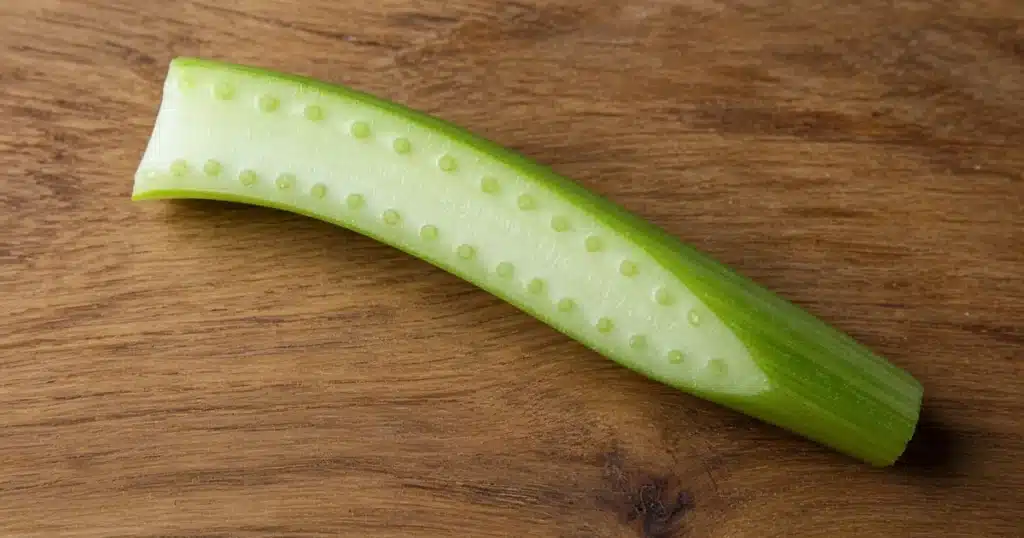
- Look for colored dots, which mark the water carrying tissue.
- Compare with leaf veins held up to the light.
Troubleshooting
No color in the celery: the cut end may have sealed. University of Georgia Extension says to cut the stem under water so the vascular tissue stays open.
Pale dots: the dye is too weak. Use enough drops so the water isn’t transparent.
Dots hard to see: look at a thin slice with a hand lens or microscope.
Tree declining after trimmer damage: a cut around the trunk can sever the vascular ring in a dicot tree. Steer trimmers away from bark.
Strands that link roots to leaves
Vascular bundles pair xylem and phloem into strands that move water up and food around. Their layout tells monocots from dicots. To see how veins look in a leaf, read cannabis leaf anatomy on the Kind Seed Co blog.
Sources
- Extension Gardener Handbook, chapter 3: Botany, NC State Extension
- Tree anatomy 101, Iowa State University Extension Natural Resources
- Tree and botanical glossary, Utah State University Extension Forestry
- Moving fluids in plants: experiments with celery, University of Georgia Extension
FAQ
Are leaf veins vascular bundles?
Leaf veins carry the plant's vascular tissue out into the leaf. North Carolina State Extension uses vein pattern to tell plant groups apart. Monocots have parallel major leaf veins, while dicots have netted veins, matching the different ways their stem bundles are arranged.
What is the difference between xylem and phloem?
North Carolina State Extension says xylem moves water and minerals, while phloem conducts food. Iowa State University Extension adds that phloem moves sugars, amino acids, vitamins, hormones and stored food. In a vascular bundle, the two tissues run side by side.
Do monocots have vascular cambium?
Not in the way dicots do. North Carolina State Extension says secondary growth is absent in monocots. In woody dicots, the vascular cambium sits just inside the phloem and makes new xylem and phloem, which widens the stem each year.
Why can a palm survive a trimmer cut that kills an oak?
North Carolina State Extension says a string trimmer can girdle a dicot tree by severing the vascular ring just inside the bark. A palm is a monocot with bundles scattered through the whole trunk, so the same wound does minimal damage.
Why cut celery under water for the dye activity?
University of Georgia Extension says to cut the bottom of the stem while it is submerged so the vascular tissue stays open. The dye then moves up the stalk, and a cross section after an hour shows which tissues carry water.



